

Kyle’s Rating: 7/10
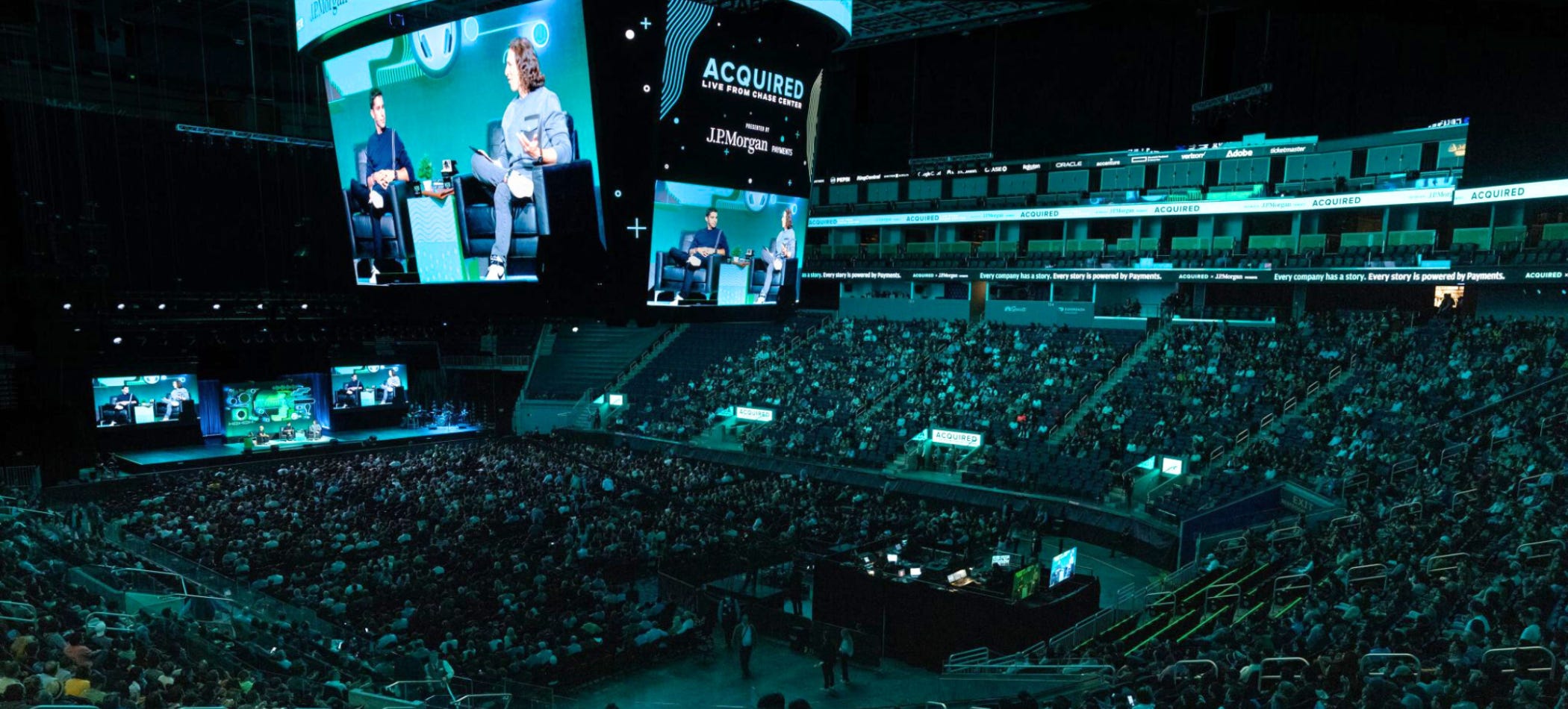
This is the full recording of Acquired’s sold-out live show at San Francisco’s Chase Center, with Daniel Ek, Emily Chang, a video from Jensen Huang and a closing interview with Mark Zuckerberg. The best segment is Emily Chang walking the hosts back through their old grades on YouTube, LinkedIn, SpaceX and Taylor Swift, which turns the show’s mistakes into a lesson in how hard it is to judge a deal early. If you’ve already heard the standalone Zuckerberg interview, the first hour is the new material, and it moves faster than a normal episode.
Key Takeaways
Acquired grows one listener at a time. Ben says the show does no paid marketing, so each listener telling about one more listener a year has driven all of its doubling. Daniel Ek’s Spotify data showed listening hours and followers both tripling in a year, with a spike after a Wall Street Journal article in May.
Spotify follows what users are already doing. Ek says the company found audiobooks because they were already showing up in Germany, uploaded as music tracks. His rule is that when people use a product despite a bad experience, you’ve found something.
The hosts’ early grades missed the AI recommendation feed. In 2016 they gave Google’s YouTube purchase a C, doubting anyone would go to YouTube to discover things. David says they missed that recommendation feeds were turning YouTube into the ultimate destination, and both now grade it an A-plus.
Some deals look better years later. LinkedIn has grown revenue about 5x inside Microsoft, and SpaceX’s Starlink alone is worth more than the whole company was when the hosts covered it. Taylor Swift may be generating around $550 million of free cash flow a year, by David’s math.
Jensen Huang’s “I wouldn’t do it again” was about ignorance, not regret. Huang says the full weight of 31 years of hardship, known in advance, would have stopped anyone. Not knowing how hard it would be is part of a founder’s superpower.
Episode Overview
Venue: Chase Center, San Francisco, sold out at 6,000 people
Hosts: Ben Gilbert and David Rosenthal
Guests: Daniel Ek (Spotify), Emily Chang (Bloomberg, The Circuit), Jensen Huang (Nvidia) by video, and Mark Zuckerberg (Meta), with a video welcome from Jamie Dimon (JPMorgan Chase)
Format: Three acts: a state-of-Acquired conversation with Ek, a “speedrun” revisit of old episodes with Chang, and the Zuckerberg interview after intermission
Partner: J.P. Morgan Payments, whose CMO, Dustin Sedgwick, the hosts credit as the driving force behind the night
Note: The Zuckerberg conversation was also released earlier as its own episode, which has a separate briefing
The Show
The opening
After Jamie Dimon welcomed the crowd by video, the hosts answered the most common listener request, to hear what gets cut from their nine-hour recording sessions, with a montage of real outtakes: running out of steam five and a half hours in, deciding to start over 35 to 40 minutes in, and a lot of “cut that.”
Then they threw out the usual format. David called the night a celebration of technology, the Bay Area and the listeners, and Ben noted it was a rare look at the present for a show that usually studies the past.
Daniel Ek on the state of Acquired
Ek brought Spotify data: over five million hours of Acquired listening on Spotify in the past year, triple the year before, which Ben worked out as more than 400 years. Followers on Spotify passed 250,000, also tripled, and listening grew worldwide, including about five times in Mexico and strong growth in Hong Kong, Israel and Singapore. David says the Wall Street Journal article in May made the first visible kink in the chart in the show’s decade.
Asked what’s next, Ben thinks the audience could be at least 10 times bigger with the same product and one episode a month, and says he’ll be dragged “kicking and screaming” into more video, because people listen while they do other things. Ek’s advice is to watch what fans already do around the show and build there.
How Spotify works
Ek met Mark Zuckerberg through Sean Parker around 2008 or 2009, at a barbecue at Zuckerberg’s small house. Spotify invites were a social currency before the US launch, and the Facebook integration that showed friends’ listening launched alongside Spotify in the US. That friend-activity feature still exists on desktop, and Spotify’s Jam feature for shared listening now carries the social idea forward.
Spotify’s internal saying is “talk is cheap”: because licensing a change could take one or two years, the company debates and plans before building. Ek says Spotify entered podcasting in 2019 and led most markets by 2022, partly by betting that listeners wanted one app for all listening rather than a separate podcast app.
Emily Chang regrades the hosts
Chang opened with YouTube, where David gave Google’s purchase a C in 2016 and Ben said it could be a C-minus. YouTube’s revenue has grown from about a $5 billion run rate then to $35 billion to $40 billion now, though Google doesn’t report its profit and YouTube pays creators 55% of long-form revenue and 45% of Shorts revenue. Ben now calls it an A-plus as a strategic purchase, given the risk to Google if YouTube had grown up somewhere else.
LinkedIn, which the hosts covered three days after Microsoft bought it and both graded an A, now has over $16 billion in revenue, including about $5 billion from advertising and content that barely existed in 2016. Ben estimates it would be worth over $100 billion as an independent company. Chang shared a quote from LinkedIn co-founder Reid Hoffman describing Satya Nadella as a “re-founder” of Microsoft.
SpaceX, which the hosts never graded, was valued at $36 billion when they covered it in May 2020, after 26 launches that year. It did 96 launches last year and plans 118 this year, and David says Starlink alone is now worth more than the whole company was then.
On Taylor Swift, which they graded an A-plus two years earlier, David estimates about $550 million of free cash flow in the last 12 months, the same as Forbes’s estimate of her entire net worth at the time of the episode.
Jensen Huang’s correction
A clip from the hosts’ Nvidia interview, where Huang said he wouldn’t start the company again, drew tens of millions of views and press coverage. The hosts took it down because they felt it was misunderstood, and invited Huang to explain by video.
Huang said of course he would start Nvidia again knowing how it turned out. His point was that 31 years of challenges, compressed into the head of a 29-year-old, would have stopped anyone from starting. Not knowing how hard it will be is part of what lets founders begin.
Mark Zuckerberg
Zuckerberg wore a shirt reading “pathemathos,” learning through suffering, from a series of shirts he designed with fashion designer Mike Amiri. He explained Meta’s bet on smart glasses, his habit of shipping early to learn faster, the 2012 rewrite of Facebook’s mobile apps that he calls a year-and-a-half mistake, and the political misjudgment after 2016 that he calls a 20-year mistake.
He traced his control of the company to 2006, when Yahoo offered $1 billion, his management team wanted to sell and the board tried to fire him. He also named Apple as Meta’s main competitor for the next 10 to 15 years, in a contest between closed and open platforms.
Deep Dive: Grading the Old Grades
Emily Chang’s segment came from the second most common email the hosts get: you got this one wrong, or a lot has happened since. The revisits show how differently a deal can look years later.
YouTube: from C to A-plus. In 2016, Ben was bearish because YouTube “is not a destination,” and David asked who goes to YouTube to discover something. What they missed was AI recommendation feeds, built with GPUs at Google and Facebook, which turned YouTube into a destination. Chang cites analysts who value YouTube at about half a trillion dollars, and $70 billion paid to creators over three years.
LinkedIn: right grade, wrong reason. The A held up, but not because anyone foresaw the growth. Revenue rose about 5x in eight years, and for Acquired itself, LinkedIn engagement runs 5 to 10 times higher than on other social platforms.
SpaceX: the side project became the business. David says launches were never the interesting part. Ben estimates Starlink at about $6.5 billion of 2024 revenue, reportedly profitable, with something like 3 million subscribers and about 7,000 satellites, which he believes is two-thirds of everything in orbit.
Taylor Swift: valuing a person as a company. David’s case: a reported $100 million-plus last year from Spotify streaming alone, at high margins because she now owns the rights to much of what gets streamed; about $1.1 billion in 2023 Eras Tour gross, which at a 30% to 35% margin is $300 million to $350 million; and a concert film that grossed $267 million plus a $75 million Disney streaming deal. At Disney’s multiple of about 20 times free cash flow, that implies an $11 billion enterprise value. Ben thinks 20x is too high for one artist coming off an outlier year.
Ben’s point is that people value someone like Swift at the cash in her bank, a multiple of one, when she is really an enterprise. Both hosts declined to call peak Taylor, Ben “for my own safety.”
By the Numbers
6,000: people at Chase Center
5 million+: hours of Acquired listened to on Spotify in the past year, triple the year before
400+ years: that listening, by Ben’s math
250,000+: Acquired followers on Spotify, also tripled
About 5x: Acquired’s listening growth in Mexico
A few million to 150 million+: Spotify podcast listeners in 2019 compared with today
About $5 billion to $35–40 billion: YouTube’s revenue run rate in 2016 compared with today
55% / 45%: share of YouTube long-form and Shorts revenue paid to creators
$70 billion: YouTube payouts to creators over three years, per Chang
$16 billion+: LinkedIn’s revenue today, about 5x what it was at acquisition
5 to 10x: Acquired’s engagement on LinkedIn compared with other social platforms
$36 billion: SpaceX’s valuation when the hosts covered it in May 2020
26 → 96 → 118: SpaceX launches in 2020, last year and planned this year
About $550 million: Taylor Swift’s free cash flow in the last 12 months, by David’s estimate
$267 million: box office for the Eras Tour concert film
31 years: of challenges Jensen Huang says no 29-year-old should know about in advance
$1 billion: Yahoo’s 2006 offer for Facebook
Best Lines
“Your superpowers are partly your ignorance.” Jensen Huang, explaining what he meant about not starting Nvidia again
“When your product is being used in spite of it actually being a pretty terrible experience, you know you’ve got something.” Daniel Ek, on finding audiobooks
“I don’t apologize anymore.” Mark Zuckerberg, joking after Huang’s correction video
“The political miscalculation was a 20-year mistake.” Mark Zuckerberg, on Meta after 2016
“Put a wall in front of us, there’s going to be a Mark-shaped hole.” Mark Zuckerberg, on why Meta runs toward its goals
Water Cooler Material
The show almost opened in silence. David’s first line on stage asked whether Ben had brought the thumb drive with the “Who Got The Truth” MP3 for the sound crew. Ben had emailed it three weeks earlier.
The tuxedo wake-surfing video was real. Chang went wake surfing with Zuckerberg and confirmed he can do a “dry start,” riding the board straight off the boat, which explains his Fourth of July video.
Daniel Ek won’t play sports with Mark Zuckerberg. Ek’s rule is to avoid competing with him, citing the time Zuckerberg tore his ACL rather than give up.
Emily Chang’s LinkedIn morning. When Microsoft bought LinkedIn, her producer couldn’t reach her and called her husband, who told her she was interviewing Satya Nadella and Jeff Weiner in an hour.
Zuckerberg didn’t think Facebook was a company. Driving down Highway 101 after moving to Silicon Valley, he looked at eBay and Yahoo and hoped to build a company someday, while already running Facebook.
The steer that won’t stay put. At Zuckerberg’s Kauai cattle ranch, where he’s trying to raise the world’s best beef, one steer keeps breaking out of steel enclosures.
August’s career plan. After a Taylor Swift concert, Zuckerberg’s daughter said she wanted to be like Swift. Told that wasn’t available, she decided she wanted people to want to be like her.
A shirt in size Zuck. The hosts gave Zuckerberg a one-of-one shirt printed with the GPS coordinates of Harvard’s Kirkland House, where he wrote Facebook’s first code, and Chase Center. Hermès dressed the hosts for the night.
Carveouts
The live show didn’t include carve-outs.
Links
Episode Metadata
Title: Acquired LIVE from Chase Center (with Daniel Ek, Emily Chang, Jensen Huang and Mark Zuckerberg)
Season / Episode: Fall 2024, Episode 1
Release Date: September 30, 2024
Length: 2:17:19