


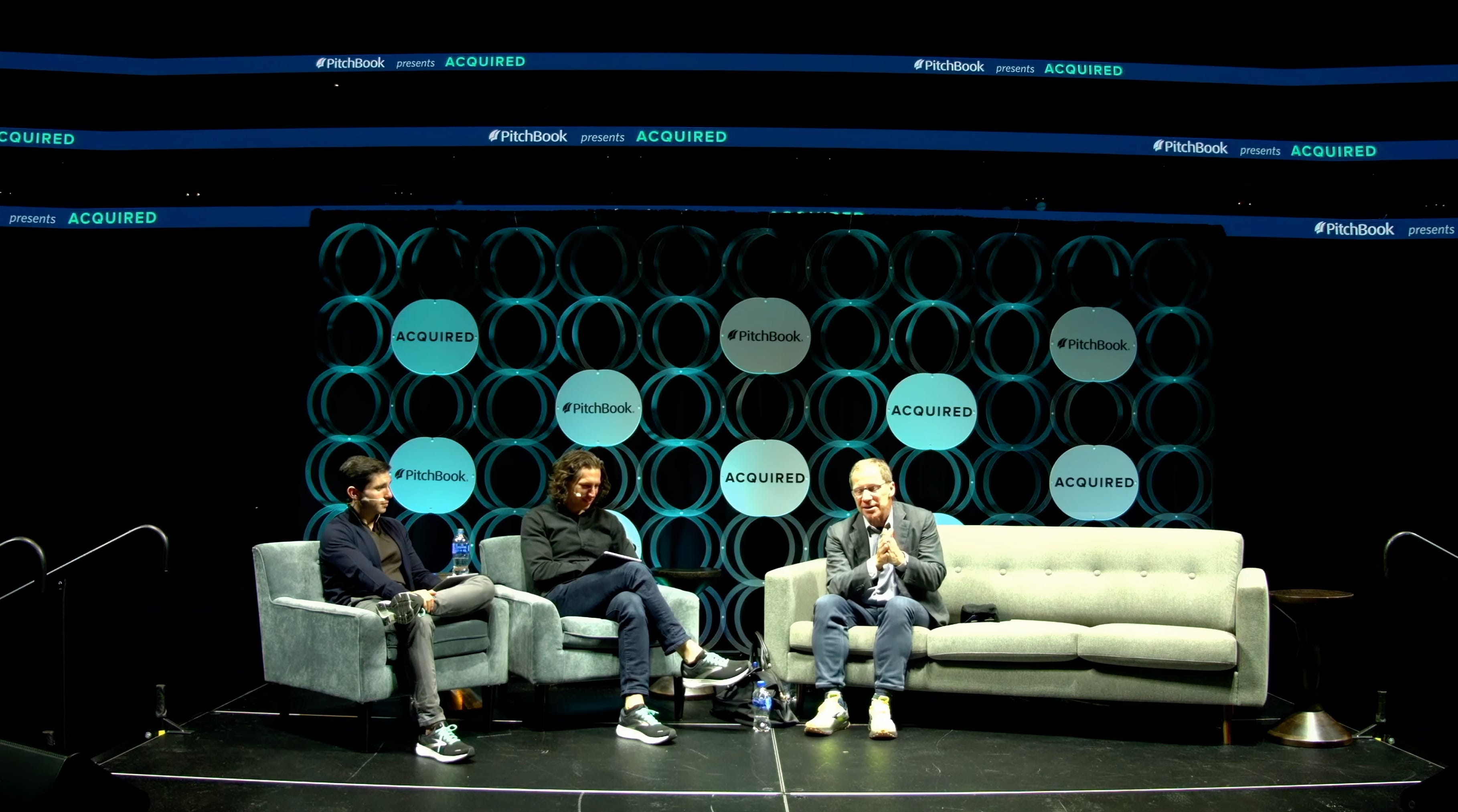
Kyle’s Rating: 8/10
This episode shines through Jim Weber’s infectious enthusiasm and genuine warmth, making the conversation about Brooks Running’s remarkable turnaround impossible not to enjoy. While the story deserves a dedicated full-length deep dive, this concise hour-long edit delivers compelling insights
Jim Weber
Jim Weber is the CEO of Brooks Running, a role he has held since 2001, transforming the company from a struggling, diversified athletic footwear maker into a focused, premium performance running brand and key Berkshire Hathaway asset. As an innovator and turnaround specialist, Weber’s significance lies in reviving underperforming businesses, having previously led successful revivals at Coleman divisions, O’Brien Watersports, and SIMS Sports before joining Brooks’ board in 1998 and stepping in as CEO during a crisis.
The interview focuses on Weber’s reflections on Brooks’ dramatic turnaround, emphasizing pivotal strategic shifts like narrowing to performance running, navigating ownership changes, and building a runner-obsessed culture. He shares personal anecdotes, such as getting kicked out of the US Olympic Trials for guerrilla marketing and his battle with esophageal cancer, alongside standout moments like direct conversations with Warren Buffett that elevated Brooks within Berkshire. The episode frames Weber’s narrative through deep dives into his long-term vision, resilience during crises like the Great Recession and COVID-19, and commitment to enjoying the journey while pursuing ambitious growth goals.
Notable Facts
Brooks was collapsing in 2001, with $60 million in revenue, $30 million in debt, losing $5 million annually, and a week from missing payroll, prompting weekly board meetings to secure funding.
Under Weber’s leadership, Brooks grew from $60 million in revenue in 2001 to $1.13 billion in 2021, achieving consistent 20%-40% annual growth recently while maintaining over 50% return on tangible net assets for 15 years.
Brooks became the number one US running shoe brand in the performance category with 21.5% market share in the last 12 months, surpassing competitors through focused innovation in trainers like the Ghost and Adrenaline.
The company hasn’t raised external capital since 2001, generating cash flow from high-margin, premium products (average selling price $130), and operates as an asset-light business with only one company-owned store.
Frequent runners, averaging 2.6 pairs of shoes annually, drive Brooks’ business model, with the brand earning loyalty through biomechanics-focused design and dominating major marathons like Boston and Houston.
Key Decisions
Focusing exclusively on performance running and cutting all non-running product lines (football cleats, court shoes, barbecue shoes) in 2001-2002: During a crisis where low-margin diversified products drained cash, Weber concentrated on the $30 billion global running category, the largest in athletic footwear, targeting frequent runners who view shoes as essential equipment, while benchmarking against public peers for higher margins. This generated $10 million cash in the first nine months by shrinking inventory and exiting unprofitable retailers, enabling profitability and growth through franchise products like the refined Adrenaline shoe. Success stemmed from Weber gaining team trust via achievable plans and bonuses, exploiting an industry where no brand had gone all-in on running, and leveraging competitive advantages in a recession-resistant, consumable category that rewarded focus over broad platforms.
Negotiating independence during ownership transitions, first with Russell Athletic in 2006 and then Fruit of the Loom in 2008: Weber pitched the company as a “crazy uncle” needing autonomy to avoid relocation or integration that could erode talent and brand momentum. This preserved Seattle operations and runner-centric strategies, tripling the business from 2009-2014 and achieving elevation to a direct Berkshire subsidiary in 2011 after Weber’s personal pitch to Buffett. The outcome highlighted Weber’s strategic foresight in playing the “long game,” turning potential disruptions into stability, and capitalizing on Berkshire’s understanding of brand moats in a competitive landscape dominated by lifestyle platforms.
Turning the supply chain back on early during the COVID-19 pandemic in March-April 2020, based on runner participation data: Facing global retail shutdowns freezing 90% of sales channels, Weber hypothesized running’s resilience as a low-cost, socially distanced activity, validated through Strava data showing daily activity growth and field counts in parks. This enabled a pivot to digital (80% of sales by April), achieving 27% growth in 2020 and 31% in 2021 despite supply issues. The decision underscored Weber’s runner-obsession, multichannel agility in a disrupted industry, and competitive edge over broader brands lacking clarity on demand recovery, turning crisis into accelerated market share gains.
Investing heavily in biomechanics-focused R&D and digital engagement while avoiding over-diversification: Motivated by the need to differentiate in a category where product fit and ride prevent injuries, especially for beginners, Weber prioritized clinical materials engineering over broad sports, sustaining innovation in trainers. This built sticky loyalty (90% product usage in actual runs) and digital tools like the Brooks Run Club, contributing to cracking $1 billion in revenue without needing capital.
Launching guerrilla marketing tactics, such as the Runhappy airplane banner at the 2012 US Olympic Trials: Responding to Nike’s 27-year exclusive deal locking out branding at events, Weber’s team hired a plane to fly banners celebrating athletes, defying demands to stop. Though resulting in ejection, it amplified Brooks’ approachable, fun brand in the running community, boosting visibility among key retailers and enthusiasts. The move reflected Weber’s fighter mentality, turning industry exclusion into a viral story that reinforced competitive positioning against podium-focused rivals.
Key Quotes
“The secret to success is constancy of purpose.”
Context: Weber wrote this Benjamin Disraeli quote on his board upon joining Brooks in 2001, using it to rally the team amid crisis and ownership uncertainty.
Analysis: This encapsulates Weber’s long-term strategy of building brand value over quick flips, influencing his decisions to focus on running and negotiate independence, while linking to industry trends like sustained runner participation growth; it powered Brooks’ turnaround by fostering resilience, turning a near-bankrupt firm into a Berkshire jewel through consistent execution in a competitive, platform-dominated space.
“Companies with issues get sold, companies with opportunity attract investors.”
Context: Shared with the Brooks team during the 2001-2006 period to shift mindset toward future growth amid Whitney’s liquidity needs and the path to Russell acquisition.
Analysis: It highlights Weber’s leadership in reframing crises as value-creation opportunities, directly tying to key decisions like product focus that generated cash and attracted Buffett; in Brooks’ journey, it underscores how premium, runner-centric strategies created a moat in a $30 billion category, mitigating risks from broader economic downturns and emphasizing impact on health-focused trends.
“We’re basically about you and your run. We’re not about the podium.”
Context: Describing Brooks’ brand positioning during discussions on differentiating from victory-oriented competitors like Nike.
Analysis: This quote captures the inclusive, performance-but-approachable ethos that drove market share gains, linking to powers like business model execution by targeting 39,999 non-winners in marathons; it shaped Weber’s strategy amid industry shifts toward fitness over elite sports, enhancing loyalty and growth in a consumable category vulnerable to injury risks.
“Running made the cut.”
Context: Reflecting on early COVID-19 insights from Strava and park counts, confirming running’s viability as a safe activity during the pandemic leading to digital sales surge.
Analysis: It signifies Weber’s data-driven agility in crises, influencing supply chain reactivation and 27% growth in 2020; tied to trends like recession-resistance and digital savvy among runners, it amplified Brooks’ competitive advantage, demonstrating how focused obsession on participation metrics outpaced diversified rivals.
“I want to soak in everything I can on any given day.”
Context: From Weber’s personal reflection on battling esophageal cancer while leading Brooks, deciding to continue as CEO without living in fear.
Analysis: This reveals his journey-oriented philosophy, informing leadership themes like enjoying the process amid challenges; it connected to Brooks’ success by reinforcing purpose-driven culture, impacting decisions like long-term global vision and linking to powers through sustained execution, while highlighting personal resilience in an industry demanding constant innovation.
Industry Trends
Running as a recession- and pandemic-resistant fitness pursuit: Its low-cost, convenient nature drove participation booming post-Great Recession (double-digit growth in Italy and Spain despite high unemployment) and during COVID-19 (Strava data showing daily increases, leading to 27% Brooks growth in 2020). This shaped Weber’s early supply chain reactivation and focus on trainers, creating competitive advantages in multichannel digital shifts but risking disruption if global manufacturing halts.
Women’s influence in running since Title IX in the 1970s: Women doubled the business, driving growth since the mid-1990s through equalized sports funding. This informed Brooks’ inclusive branding and product design (run bras), linking to leadership principles of approachability and powers like scale in premium consumables, while posing risks from competitors targeting lifestyle over performance.
Digital engagement and data in running: Trends like quantified self via apps (Strava, Apple Watch) and e-commerce rising to 80% of sales during COVID, with runners starting journeys online. This influenced Brooks’ investments in active evaluation ads and Run Club, enhancing advantages in runner loyalty but requiring navigation of monetization challenges seen in rivals’ failed apps.
Leadership Playbook
Embrace the journey over fleeting finish lines: Using exact terminology like “the journey is to just be cherished and enjoyed because the finish lines are fleeting,” Weber stresses enjoying daily pursuits amid goals, shaping his approach to long-term brand building and personal resilience during cancer. In running’s industry, this implies leading with positivity and inclusivity, linking to trends like pandemic participation by fostering agile, runner-focused teams.
Lead with product and customer obsession: Framed as “sweating product” through focused R&D on biomechanics and “obsession on runners,” this principle drove decisions like narrowing lines and digital pivots, emphasizing execution at scale. It has implications for competitive industries, promoting moat-building via loyalty over broad diversification, tied to trends in digital data for personalized engagement.
Additional Notes
Episode Metadata:
Title: Arena Show Part II: Brooks Running (with CEO Jim Weber) (Season 10, Episode 8)
Duration: 1:10:56
Release Date: May 15, 2022
Related Episodes:
Berkshire Hathaway Part I (Season 8, Episode 5, 4/20/2021)
Berkshire Hathaway Part II (Season 8, Episode 6, 5/12/2021)
Berkshire Hathaway Part III (Season 8, Episode 7, 6/6/2021)
Links:
Jim’s book, Running with Purpose