

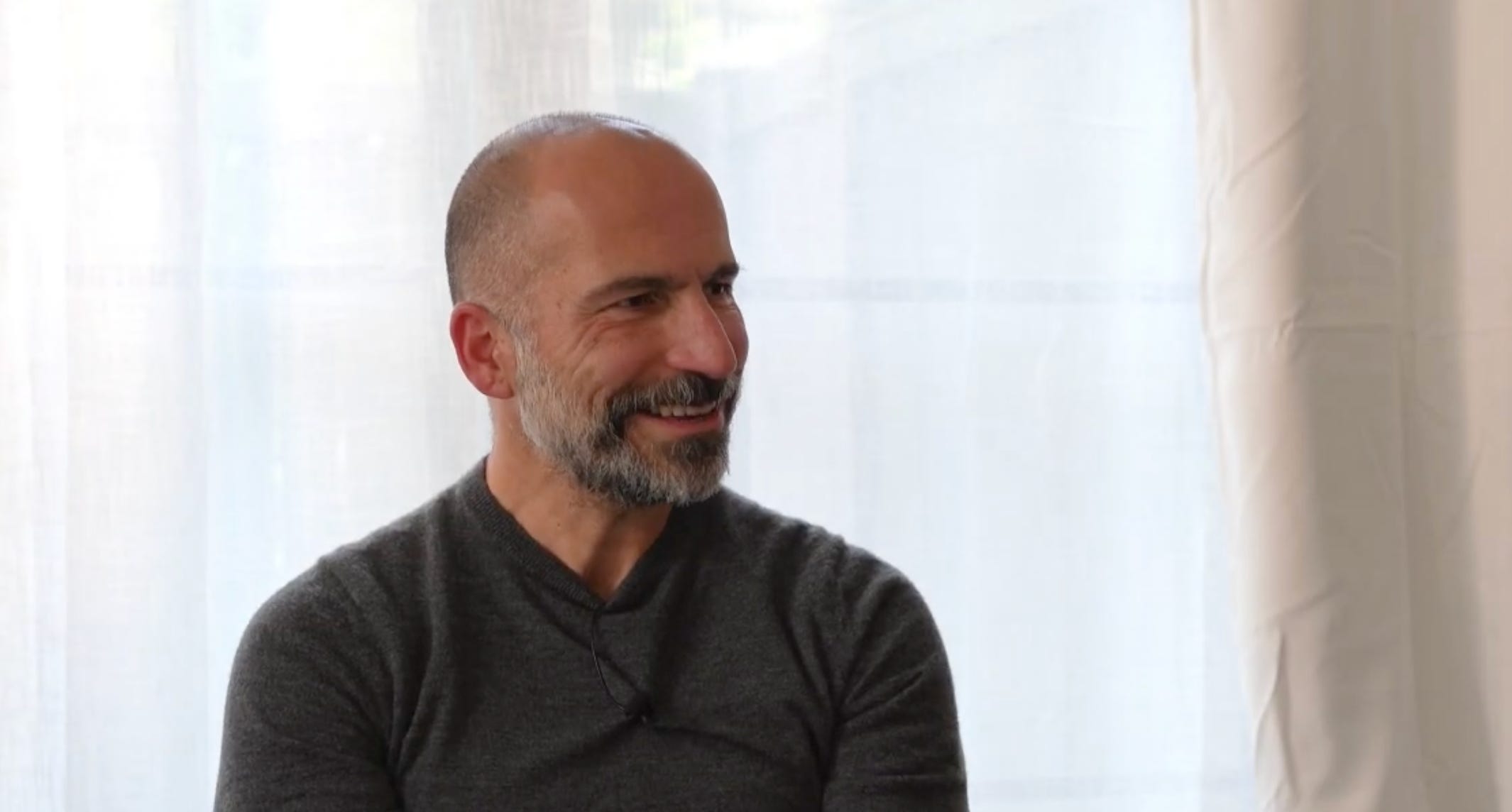
Kyle’s Rating: 6/10
While the interview provided fascinating insights into Dara Khosrowshahi’s career journey and a nuanced, insider perspective on Uber’s transformation and marketplace dynamics, it fell short of the depth and rigor found in Acquired’s signature full-episode deep dives. The conversation felt more like a casual chat than a comprehensive analysis, making it enjoyable but not exceptional. Unfortunately, the cheesy opening bit with the wine delivery detracted from an otherwise solid discussion.
Dara Khosrowshahi
Dara Khosrowshahi serves as CEO of Uber, having previously been CEO of Expedia and a key executive at IAC under Barry Diller. He is a pivotal figure in the travel and mobility sectors, renowned for steering companies through crises like post-9/11 recovery and Uber’s transformation from a scandal-plagued cash-burner to a profitable global platform.
The interview centers on Khosrowshahi’s career arc, from his early days at Allen & Company to navigating high-stakes deals and turnarounds. It weaves in personal anecdotes, such as buying Expedia amid 9/11 uncertainty and the secretive Uber CEO search, alongside reflections on pivotal moments like the SoftBank investment and shareholder overhaul. The episode frames his narrative through operational discipline, marketplace flywheels, and a shift toward earner-centric innovation, highlighting his evolution from travel operator to architect of on-demand economies.
Timeline
1989: Joined Allen & Company as an analyst out of college, assigned to Barry Diller’s QVC bid for Paramount Pictures.
Early 1990s: Worked directly with Diller on the hostile tender offer for Paramount, presenting LBO models amid bidding wars and court battles.
2001: IAC signed term sheet to acquire Expedia pre-9/11; closed the deal post-attacks despite MAC clause, providing stability during travel industry collapse.
2004–2017: Served as CEO of Expedia, growing it through global expansion while competing against Booking.com‘s supply-led dominance.
2017: Recruited via headhunter for Uber CEO role during summer; accepted after two months of secretive process, starting amid scandals and leadership vacuum.
2017–2018: Navigated Uber’s post-Travis Kalanick era, including London license revocation, data breach, and SoftBank’s $15B investment requiring high-vote share conversion.
2019: Uber IPO’d after burning record pre-IPO capital; Khosrowshahi focused on operational turnaround to break-even.
2020–2021: Pandemic slashed 85% of mobility volume; divested non-core assets like autonomy hardware, accelerating Eats growth.
2022–2023: Achieved cashflow positivity; revenue tripled to over $30B on $120B GMV, with drivers/couriers earning 30% more year-over-year.
2023: Expanded into groceries, liquor, and taxi integrations; separated Eats fulfillment tech for merchant partnerships like Walmart.
Notable Facts
Uber’s 5.6 million drivers and couriers form the world’s largest source of gig work, with 90% repeat earners driving platform liquidity.
Post-pandemic, Eats serves as Uber’s primary customer acquisition channel, converting rides users at one-quarter the cost of external ads like Google or Meta.
Khosrowshahi’s 20-year partnership with Barry Diller began with a high-stakes Paramount bid, where he presented models directly to the media mogul as a junior analyst.
Uber’s marketplace now wires up 4.5 million global taxis, using blast dispatch tech to match riders to fleets, blending old systems with dynamic pricing.
Expedia’s take rate dropped from 25% to 17% under Khosrowshahi, prioritizing volume growth over margins—a lesson applied to Uber’s 20% cap for ecosystem durability.
Key Decisions
Acquiring Expedia post-9/11 (2001): Amid travel’s cliff-fall and a MAC clause allowing exit, IAC closed the unchanged deal after Barry Diller’s conviction that “if there isn’t travel, there is life,” providing Rich Barton stability. This preserved Expedia’s momentum, enabling 13 years of growth under Khosrowshahi; his supply-led focus later mirrored Booking.com‘s fragmentation strategy, turning a crisis bet into a resilient marketplace that outlasted macro shocks through operator loyalty and reversion to norms.
Joining Uber as CEO (2017): Recruited secretly via headhunter Daniel Ek’s nudge at Sun Valley—”since when is life about having fun? It’s about impact”—Khosrowshahi accepted despite Expedia bliss, pitching operational maturity over strategy. This outsider hire ended internal power struggles, stabilized a $10B revenue burner losing to Lyft; his earner-first pivot rebuilt trust, compounding to $30B revenue and dominance by prioritizing duty of care over hype, contrasting Travis Kalanick’s aggression in a maturing gig economy.
SoftBank investment and high-vote share conversion (2018): Facing a $15B Vision Fund ultimatum and control battles, Khosrowshahi negotiated unanimous shareholder buy-in to eliminate super-voting shares, averting a Lyft-favoring rival bid. This democratized governance, shifting from founder dominance to collaborative building; it unlocked capital for Eats acceleration during pandemic cuts, fostering profitable growth (22% bookings rise) by aligning incentives in a high-stakes prisoner’s dilemma that neutralized activist risks.
Pandemic divestitures and Eats acceleration (2020): With 85% mobility volume gone and $2.5B losses deepening, cut non-core units like autonomy and hardware, betting on rides/Eats core while using Eats for driver recruitment sans car inspections. This supply-led flywheel—converting 90% of new earners via Eats—drove 30% earner pay growth and category share gains vs. Lyft/DoorDash; Khosrowshahi’s discipline, honed from 9/11, embedded resilience, turning crisis into compounding margins (5% yearly marketplace throughput gains) amid suburban biases exposed by competitors.
Taxi integrations and blast dispatch (2023): Evolved from challenger to incumbent by wiring 4.5M global taxis via hybrid matching, deploying one-to-many dispatch to boost acceptance rates where one-to-one failed. This liquidity enhancer countered urban biases, blending legacy fleets with UberX for 98% fulfillment; Khosrowshahi’s adaptive leadership—tuning tech for P95 earner experiences—mitigated competitive copycats, expanding into suburbs and two-wheelers to sustain 50% growth from new bets in a fragmenting transport ecosystem.
Key Quotes
“If there isn’t travel, there is life.”
Context: Barry Diller’s quip during IAC’s post-9/11 Expedia deliberations, cutting through MAC clause debates.
Analysis: This encapsulated Khosrowshahi’s early crisis navigation, embodying reversion-to-norm wisdom that stabilized Expedia’s supply chain; it foreshadowed his Uber playbook of betting on human rhythms over panic, linking to scale economies in marketplaces where macro shocks test but ultimately reinforce network effects through operator grit.
“Since when is life about having fun? It’s about impact.”
Context: Daniel Ek’s Sun Valley persuasion during the secretive Uber CEO search, overriding Khosrowshahi’s contentment at Expedia.
Analysis: Ek’s challenge reframed Khosrowshahi’s career from comfort to stewardship of a “verb” company, driving the outsider hire that ended scandals; it ties to his earner duty-of-care shift, amplifying Uber’s real-world influence on 5.6M gig workers and countering tech’s elite disconnect in a trends-driven gig surge.
“Don’t overplan your career... When you get that opportunity, going all in.”
Context: Advice to young professionals, drawn from stumbling into Allen & Company via a failed romance and rising through Diller’s unvarnished-truth demands.
Analysis: This principle fueled Khosrowshahi’s improbable path from paint-factory fallback to Uber turnaround, emphasizing bias-avoidance in volatile industries; it connects to supply-led growth decisions, where openness to pivots—like Eats-to-rides conversions—built competitive moats against execution machines like DoorDash.
“We’re not setting prices. The marketplace is setting its own price.”
Context: Explaining Uber’s surge dynamics amid complaints of rising fares, highlighting counter-cyclical self-regulation.
Analysis: Khosrowshahi’s economist-backed view underscores invisible-hand efficiencies in fragmented supply (5.6M earners), enabling 24% unit growth in soft economies; it analyzes his low-take-rate discipline as a power-preserving tactic, fostering durability over short-term hikes in a labor-catch-up era.
“Tech is out of touch with the real world... Uber is unique in that it’s a technology company that’s built for the real world.”
Context: Closing reflection on evolving earner experiences, from P95 optimizations to 401(k)-like care for gig workers.
Analysis: This captures Khosrowshahi’s post-turnaround pride in bridging virtual algorithms with tangible livelihoods, addressing past oversupply neglect; it links to industry trends like suburban expansion, positioning Uber’s hybrid model as a leadership edge in democratizing work amid autonomy delays.
Industry Trends
Supply-led marketplace growth: Fragmented supply bases—like hotels for Booking.com or 5.6M Uber earners—drive liquidity via data optimization; Khosrowshahi applied this to post-pandemic driver recruitment, using Eats as a low-friction entry to upsell rides, gaining share vs. Lyft by compounding conversions and reducing surge.
Gig economy counter-cyclicality: Platforms self-regulate via labor inflows during downturns, accelerating units (Uber’s 24% Q1 growth) while raising blue-collar wages; this shaped Khosrowshahi’s open-platform philosophy, mitigating risks like supply floods through natural attrition, and highlighting Uber’s dataset edge for 5% annual throughput gains.
Hybrid fulfillment separation: Decoupling demand marketplaces from logistics (e.g., Uber’s Eats tech for Walmart) enables same-day local delivery outpacing Amazon; Khosrowshahi’s pivot exploits this for suburban penetration, countering DoorDash’s restaurant bets with structural recruitment advantages, though copying threats underscore execution imperatives.
Leadership Playbook
Bet on people over plans: Echoing Herb Allen’s mantra, Khosrowshahi threw juniors into deep ends like Diller pitches, fostering loyalty; this built Uber’s new-old team blend, enabling impact in crises like SoftBank negotiations, with implications for mobility leaders to prioritize unvarnished truth amid stakeholder chess.
Embrace duty of care for earners: Shift from B2C AB-testing to P95 humility, treating gig apps like employee tools; applied in earner pay hikes (30% YoY), this counters tech elitism, linking to trends like wage catch-up and positioning Uber as a proud real-world connector for global scale.
Go all in on opportunities: From 9/11 deal closure to Uber acceptance, unhedged commitment turns luck into compounding; in travel/mobility, it implies resisting quarterly temptations like take-rate hikes, sustaining flywheels for long-term category dominance.
Additional Notes
Episode metadata:
Title: Uber CEO Dara Khosrowshahi
Duration: 1 hour 37 minutes
Release Date: June 12, 2023
Related episodes:
The Uber IPO (Season 4, Episode 6, 5/10/2019)
Super Pumped (with Brian Koppelman and Joseph Gordon-Levitt, 2/20/2022)
The New York Times Company (Season 8, Episode 2, 2/17/2021)
Links: