

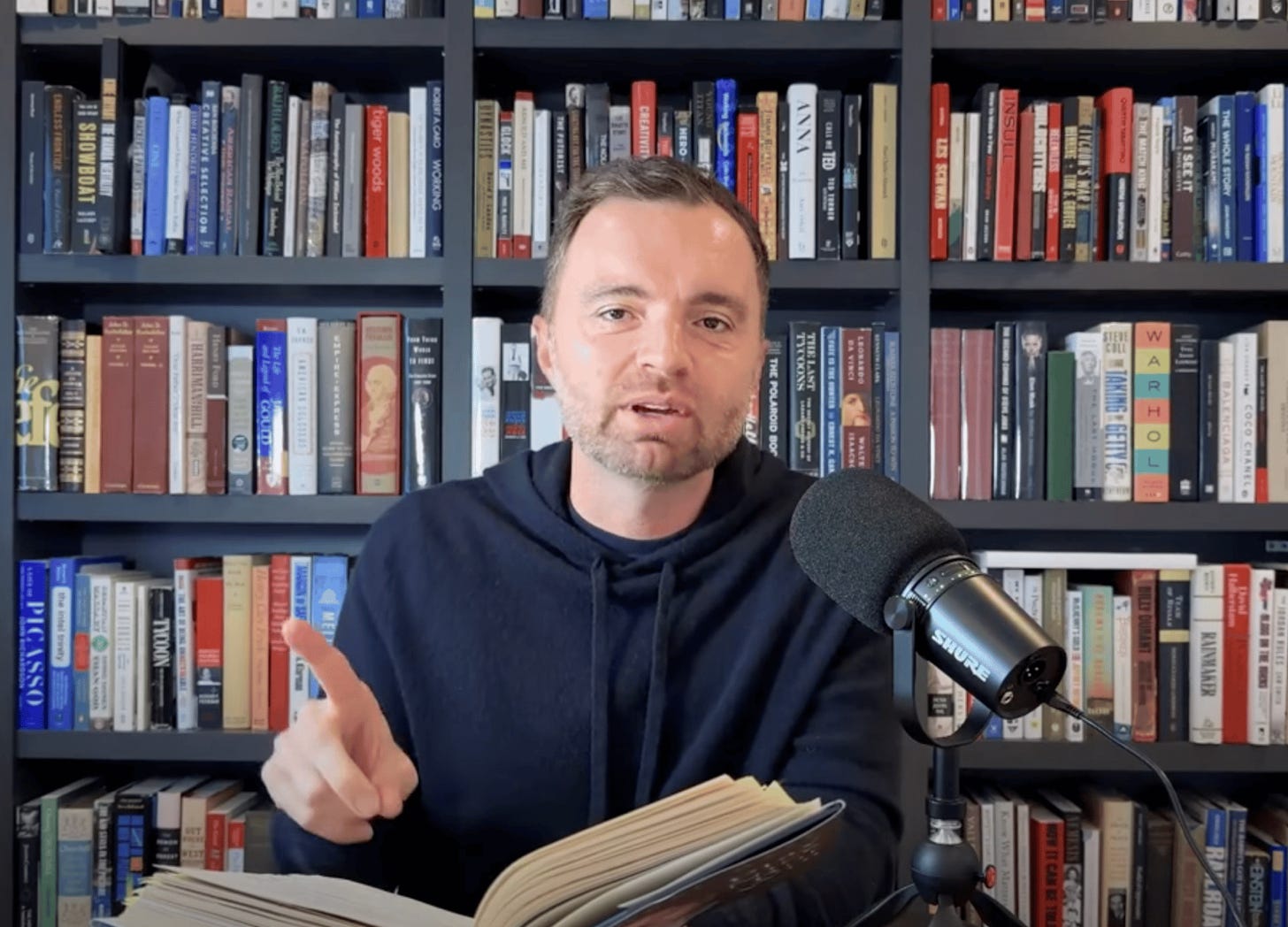
ACQ Sessions returns with David Senra of the Founders Podcast. David is one of Ben and David’s very favorite people in the world — it’s impossible to spend an hour (or 3!) with him and not come away inspired to go take over the world. This conversation is an “extended, IRL version” of their monthly calls that we do together where we share stories, swap life and podcast advice, and just genuinely enjoy sharing time with someone who shares our outlook and enthusiasm for the history of entrepreneurship.
Kyle’s Rating: 6/10
This Acquired Sessions episode broke from the show’s typical deep-dive format to explore the craft of podcasting through a conversation between David Senra, Ben, and David. Senra’s passion for reading and his background as a self-taught historian were the clear highlights, showing what drives Founders Podcast. But the unstructured conversation format isn’t where Ben and David excel—their strength is structured, narrative-driven storytelling. The episode was engaging, just not as polished as their usual work.
David Senra
David Senra, host of the Founders Podcast, is a passionate chronicler of entrepreneurial history, known for his deep dives into the biographies of history’s greatest founders. His significance lies in his ability to distill lessons from hundreds of biographies into actionable insights for entrepreneurs, making him a unique voice in the podcasting and business history space. The episode, an Acquired Sessions conversation recorded on March 28, 2023, focuses on Senra’s personal journey, his obsession with studying founders, and his reflections on podcasting, entrepreneurship, and learning from historical figures like Charlie Munger, Steve Jobs, and Sam Walton. The discussion is unstructured, spanning Senra’s dinner with Charlie Munger, his approach to storytelling, and the craft of podcasting, with personal anecdotes about his upbringing and motivations. The episode frames Senra as a relentless learner, driven by a “psychopathic search for mentors” through books, whose podcast serves as a platform to share timeless entrepreneurial wisdom.
Notable Facts
Voracious Reader and Self-Taught Historian: Senra has read hundreds of biographies, amassing over 20,000 highlights in Readwise, which he uses as a personal knowledge base to draw connections across entrepreneurial stories.
Dinner with Charlie Munger: In 2023, Senra spent three hours with 99-year-old Charlie Munger, discussing business history, with Munger’s sharp recall and storytelling leaving a profound impact.
Immigrant Background: As the son of a Cuban immigrant, Senra’s drive stems from a family history of resilience, with his grandfather escaping Castro’s Cuba, shaping his work ethic and perspective.
Autotelic Beginnings: The Founders Podcast initially launched as Autotelic, a name reflecting Senra’s intrinsic motivation to read and share knowledge for its own sake, before rebranding to focus on founders.
Podcast Influence: Senra’s podcast has attracted a high-caliber audience, including founders and investors, with one listener crediting a single idea from an episode for a $10 million improvement in their company.
Key Decisions
Starting Founders Podcast (2016):
Context/Rationale: Driven by a lifelong habit of reading and a desire to share entrepreneurial lessons, Senra launched the podcast despite no clear business model, trusting he could figure it out by dedicating himself fully. He was inspired by monologue podcasters like Dan Carlin and Bill Burr, aiming to create a unique format where he shares insights from one biography per episode.
Outcome: The podcast grew from a niche project to a significant platform with a global audience, surpassing initial expectations of 25,000 downloads per episode, and became a business that sustains his family.
Analysis: Senra’s decision reflects a contrarian approach, ignoring conventional podcasting advice (e.g., short episodes, frequent guests) to focus on long-form, solo storytelling. This aligns with his belief in differentiation as survival, a principle he attributes to Jeff Bezos, and allowed him to carve a unique niche in a crowded market. His relentless focus on learning from history gave him an edge, resonating with high-achieving listeners who value deep insights.
Rejecting Acquisition and Investment Offers:
Context/Rationale: Senra received around 15 offers to acquire or invest in Founders Podcast, but declined them all to maintain full control and align with the entrepreneurial principle of never giving up ownership, inspired by figures like Ralph Lauren and Akio Morita.
Outcome: By retaining control, Senra preserved the podcast’s authenticity and vision, allowing him to continue producing content on his terms while building a loyal audience and attracting premium advertisers.
Analysis: This decision mirrors the long-term thinking of founders like Buffett and Munger, who prioritize control to ensure alignment with their values. Senra’s rejection of short-term financial gains reflects his understanding of competitive dynamics in media, where authenticity and independence are key differentiators. It also allowed him to avoid diluting his brand’s promise, a concept he credits to Buffett.
Adopting a Free Podcast Model Over Paywalls:
Context/Rationale: Initially, Senra experimented with a paywall model, offering 30-minute previews before requiring payment. After discussions with Acquired hosts, he shifted to a free model with advertising, recognizing that the value of reaching a larger audience outweighed limited subscription revenue.
Outcome: The shift significantly increased his audience size and engagement, enabling higher-value advertising deals and aligning with David Ogilvy’s insight that “you’re not advertising to a standing army, you’re advertising to a moving parade.”
Analysis: This pivot demonstrates Senra’s adaptability and willingness to learn from peers, a trait common among successful entrepreneurs he studies. By prioritizing audience growth over immediate monetization, he leveraged network effects to amplify his reach, aligning with industry trends toward scalable, ad-supported content platforms.
Building Relationships with Like-Minded Peers:
Context/Rationale: Senra intentionally cultivated relationships with high-caliber individuals like the Acquired hosts, Patrick O’Shaughnessy, and Sam Zell, inspired by Buffett and Munger’s practice of associating with the best people. He views these connections as a source of learning and leverage.
Outcome: These relationships provided mentorship, business advice (e.g., on podcast monetization), and access to exclusive opportunities like the Munger dinner, enhancing his personal and professional growth.
Analysis: Senra’s focus on relationships reflects a strategic approach to building a network of “best-in-class” peers, a leadership principle that amplifies his influence and learning. This mirrors the competitive advantage of founders who surround themselves with talent, as seen in Buffett’s selective partnerships, and positions Senra as a hub for entrepreneurial wisdom.
Committing to Lifelong Learning Through Reading:
Context/Rationale: Senra’s lifelong habit of reading, intensified by his podcast, was driven by a need to escape a challenging upbringing and find mentors through books. He adopted a systematic approach, using Readwise to catalog insights and revisit them daily.
Outcome: This commitment gave him an “unfair advantage” of deep knowledge, enabling him to draw connections across centuries of entrepreneurial history and deliver unique value to his audience.
Analysis: Senra’s reading habit is a form of scale economies, as his knowledge compounds over time, making him a domain expert in a way few can replicate, per Bill Gurley’s advice. This aligns with the competitive dynamics of content creation, where depth and authenticity differentiate in a crowded market.
Key Quotes
“Learning from history is a form of leverage.”
Context: Senra shares this insight while discussing Charlie Munger’s approach to learning, emphasizing how studying past entrepreneurs provides actionable ideas for modern success.
Analysis: This quote encapsulates Senra’s core philosophy and the Founders Podcast’s value proposition. By framing history as leverage, he highlights its practical utility, aligning with Munger’s belief in learning from others’ mistakes to avoid repeating them. It underscores his strategic approach to podcasting, where historical insights give listeners a competitive edge in entrepreneurship, reflecting the industry trend of knowledge as a differentiator.
“You’re not advertising to a standing army, you’re advertising to a moving parade.”
Context: Senra cites David Ogilvy to explain why he shifted to a free podcast model, recognizing that new listeners constantly join the audience, requiring fresh exposure to his content.
Analysis: This quote reflects Senra’s strategic pivot to maximize reach, drawing on Ogilvy’s advertising wisdom to understand audience dynamics. It highlights his leadership approach of adapting to market realities, ensuring his podcast remains relevant in a competitive media landscape where discoverability is key.
“The best businesses are cults.”
Context: Discussing brands like In-N-Out and Trader Joe’s, Senra argues that the most successful businesses inspire cult-like loyalty, a concept he playfully applies to his podcast’s future.
Analysis: This quote captures Senra’s understanding of brand power, a key driver of success for iconic companies. By aspiring to create a “cheerful cult” around Founders, he leverages emotional engagement to build a loyal audience, aligning with industry trends where strong branding creates defensible market positions. It reflects his ambition to make his podcast a cultural touchstone for entrepreneurs.
“A brand is a promise.”
Context: Senra attributes this to Warren Buffett, using it to explain why he takes his podcast’s quality seriously, ensuring it delivers consistent value to his high-caliber audience.
Analysis: This quote underscores Senra’s commitment to authenticity and quality, a leadership principle that mirrors Buffett’s focus on trust. By treating his podcast as a promise, he builds a durable brand in a competitive media landscape, where listener trust is a key differentiator. It ties to his decision to prioritize audience value over short-term monetization.
“Charlie has an almost complete indifference to problems. Troubles from time to time should be expected.”
Context: Reflecting on his dinner with Munger, Senra shares this as his biggest takeaway, noting Munger’s resilience in facing challenges by surrounding himself with quality people and businesses.
Analysis: This quote reveals Senra’s admiration for Munger’s stoic leadership style, which influences his own approach to podcasting and life. It highlights the industry trend of resilience as a competitive advantage, as founders who anticipate and navigate problems effectively, like Munger, build lasting success. It ties to Senra’s decision to focus on high-quality relationships and content.
Industry Trends
Knowledge as Competitive Advantage: Senra emphasizes that studying history provides leverage, citing Munger’s ability to distill decades of reading into actionable insights (e.g., making $400 million from one Barron’s idea). This trend shaped Senra’s decision to create a podcast that shares historical lessons, positioning him as a knowledge hub for entrepreneurs seeking an edge in a competitive landscape.
Authenticity in Media: Senra notes that podcasting’s superpower is “authenticity at scale,” allowing hosts to build genuine connections with audiences. This trend influenced his decision to remain a solo host, ensuring his voice remains unfiltered, and aligns with his leadership principle of being true to himself, enhancing listener trust in a crowded media market.
Long-Form Content for Niche Audiences: The episode highlights the rise of long-form, niche podcasts like Founders and Acquired, which cater to high-value audiences (e.g., founders, investors). Senra’s shift to a free model reflects this trend, leveraging Ogilvy’s “moving parade” insight to reach new listeners, giving him a competitive advantage over paywalled content.
Leadership Playbook
Follow Your Natural Drift: Senra adopts Munger’s advice to pursue what naturally excites you, choosing books and topics based on personal curiosity. This shaped his podcast’s unique format, focusing on biography-driven insights, and has implications for leaders to align their work with intrinsic motivations to sustain long-term commitment in competitive fields.
Surround Yourself with the Best: Inspired by Buffett and Munger, Senra prioritizes relationships with high-caliber peers, which enhances his learning and influence. This principle, evident in his connections with Acquired hosts and others, underscores the importance of selective networks for leaders to gain insights and amplify impact in any industry.
Embrace Repetition and Improvement: Senra’s practice of revisiting highlights and refining his storytelling reflects a commitment to continuous improvement. This approach, inspired by figures like Kobe Bryant studying game tape, ensures his podcast remains high-quality, offering leaders a model for iterative growth in competitive environments.
Powers
Scale Economies: Senra’s extensive reading and 20,000+ Readwise highlights create a knowledge base that compounds over time, reducing the cost of producing each episode relative to its value. This power, evident in his ability to draw connections across biographies, makes it difficult for competitors to replicate his depth, driving his podcast’s success.
Branding: Senra’s podcast embodies Buffett’s idea that “a brand is a promise,” delivering consistent, authentic value that builds listener loyalty. This power, reinforced by his cult-like following, creates a defensible position in the podcasting market, as listeners trust his content to deliver entrepreneurial insights.
Additional Notes
Episode:
Related Episodes:
Links:
Go subscribe to Founders! Some of Ben and David’s favorite episodes: