


7 Powers author Hamilton Helmer and his Strategy Capital colleague Chenyi Shi join Ben and david to discuss their latest research on a topic that’s highly relevant to the recent Acquired canon: how to build a second business line. This incredibly important “transforming” question faces every great company who has achieved initial product success (as well as their investors). Do we continue solely along the established path, or do we attempt to grow new branches on the tree? Some companies grow new businesses with tremendous success — Amazon and AWS, Nintendo and video games, Nvidia and CUDA — yet many others fail miserably. For the first time Hamilton and Chenyi share their research-based playbook on how companies should approach this decision and choose wisely. Tune in!
Kyle’s Rating: 8/10
It was a treat to hear directly from Hamilton Helmer and Chenyi Shi—the minds behind the 7 Powers framework that’s become essential reading for entrepreneurs and strategists. The conversation felt like sitting in on an intimate business school seminar, with clear, concise explanations that made complex strategy concepts genuinely enlightening. It’s refreshing to have this type of deep-dive, founder-focused episode in the feed.
Hamilton Helmer & Chenyi Shi
Hamilton Helmer: Author of 7 Powers: The Foundations of Business Strategy, a renowned strategist with a background in economics and business. Formerly a strategy consultant at Bain & Company, a Stanford University professor, and co-founder of Strategy Capital, he focuses on long-term competitive outcomes in technology and innovation-driven companies. His work emphasizes pattern recognition for entrepreneurs to build durable businesses.
Chenyi Shi: Helmer’s colleague at Strategy Capital, collaborating on research into advanced strategy topics like platforms and corporate transformation. A former student of Helmer’s at Stanford, she brings a practitioner’s perspective, working with founders and operators. Shi applies the 7 Powers framework dynamically, emphasizing cognitive leverage for high-impact strategic questions.
Together, they blend theoretical insights with real-world examples from companies like Amazon, Nintendo, and Microsoft, sharing research on “transforming”—building second business lines—extending the 7 Powers framework.
7 Powers Framework
Hamilton Helmer and Chenyi Shi describe the 7 Powers as a framework identifying seven structural economic advantages that enable companies to achieve persistent profitability and defend against competition after securing product-market fit.
These “powers” are specific mechanisms that create durable competitive moats, distinguishing successful businesses (e.g., Apple’s iPod) from transient ones (e.g., Bowmar’s calculator). Helmer developed the framework to address the question of how entrepreneurs can avoid fleeting success by building defensible businesses, drawing from decades of studying economic vitality, inspired by Joseph Schumpeter’s emphasis on entrepreneurial dynamism. Shi views it as a tool for cognitive leverage, helping founders focus on critical strategy questions amid operational demands.
The seven powers are:
Scale Economies: Fixed costs spread over larger output reduce unit costs (e.g., Amazon’s logistics infrastructure).
Network Economies: Platform value increases with user participation (e.g., Uber’s rider-driver density).
Counter-Positioning: New models disrupt incumbents’ established approaches (e.g., Netflix’s streaming vs. Blockbuster).
Switching Costs: High barriers prevent customers from leaving (e.g., Microsoft’s enterprise software lock-in).
Branding: Perceived value justifies price premiums (e.g., Apple’s customer loyalty).
Cornered Resource: Access to unique assets (e.g., Pixar’s creative talent).
Process Power: Superior operational processes (e.g., Toyota’s lean manufacturing).
The framework shifts strategy from an open-ended “essay question” to a “multiple-choice” one, providing a mental model for entrepreneurs to navigate dynamic markets adaptively.
Unlike frameworks like Porter’s Five Forces (focused on industry attractiveness) or Christensen’s disruptive innovation (centered on product-market fit), 7 Powers emphasizes persistence—why some firms maintain profitability over time (e.g., Apple’s predictable margins vs. Samsung’s volatility). Helmer notes it’s not sequential to product-market fit; founders should consider powers early, as they guide choices toward defensible outcomes (e.g., Porsche’s consistent 911 design leveraging scale and process power).
Powers Are Simple But Not Simplistic
Helmer stresses that 7 Powers must be “simple but not simplistic” to be useful:
Simple: The framework is concise—only seven powers—making it memorable and actionable for entrepreneurs making real-time decisions. Complex theories requiring constant reference are impractical in fast-moving environments.
Not Simplistic: It’s comprehensive, covering most competitive scenarios exhaustively. The seven powers capture the core economic structures driving persistent profitability, avoiding oversimplification that misses critical nuances. For example, while Porter’s Five Forces is insightful, it doesn’t explain firm-specific profitability differences; 7 Powers does by focusing on structural advantages.
This balance ensures the framework is a practical mental model, helping founders recognize patterns (e.g., iPod’s branding and scale vs. Bowmar’s lack thereof) without being overly reductive. Shi reinforces this by noting its ongoing evolution—new insights (e.g., platforms, transformation) keep it robust yet accessible.
Powers as a Cognitive Lever
Shi describes 7 Powers as a “cognitive lever,” a tool to prioritize the 5% of time spent on strategy over the 90-95% on operational excellence (team, culture, execution). It helps founders identify “what is not important as much as what is important,” focusing on high-impact questions that determine margin structure and competitiveness. For example:
It clarifies whether a business’s power (e.g., Uber’s network economies) extends to new ventures, avoiding missteps like Uber’s China expansion.
It guides decisions on transformation by assessing if new businesses align with existing powers, reducing risk (e.g., Amazon’s logistics extension to electronics vs. risky Fire Phone invention).
It provides pattern recognition, enabling founders to differentiate defensible strategies (e.g., Nintendo’s distribution lock) from fleeting product-market fit successes.
By offering clarity on where to focus strategic effort, 7 Powers prevents wasted energy on non-differentiating factors, enhancing decision-making in complex, adaptive markets.
Transformation
Transformation is the strategic expansion beyond a company’s original business into a new line, creating a “second business” to drive value. It addresses: If successful in one business, why move into another? It makes sense if it leverages existing power (from 7 Powers) and capabilities for enhanced value capture with low risk—e.g., Amazon’s shift to AWS, utilizing shared infrastructure. It doesn’t make sense if it requires new powers/skills, reverting to risky invention (e.g., Uber’s failed “mobility” ventures like flying cars, misaligned with geographic network power).
Around 2007, Helmer found ~50% of S&P 100 profits came from non-original lines. In tech, this may be higher—e.g., Apple (iPhones), Google (Android), Microsoft (OS/applications), Intel (CPUs). This underscores transformation’s role in long-term value, though some firms thrive as single-line businesses (e.g., early Facebook).
Why Transformation Is Important
Addresses Core Limits: Overcomes market saturation, competition, and innovation plateaus.
Drives Economic Vitality: Fuels Schumpeterian creative destruction in dynamic markets.
Compounds Value: Turns hits into empires (e.g., Disney’s acquisitions like Pixar/Marvel).
Not Mandatory: Pursue only if aligned with power/capabilities, not as default growth.
Why Transformation Is Hard
Motivational Issues: Founders overestimate success (skill vs. luck/timing); VCs focus on growth over power.
Analytical Flaws: Narratives like “listen to customers” or geographic expansion prioritize value creation over capture. E.g., Uber’s China failure (non-transferable networks); marketing myopia’s mixed outcomes (Disney’s entertainment wins vs. Uber’s mobility flops).
Agency Problems: Legacy unit resistance; reinvention needs founder sponsorship.
High Failure Risk: Wastes resources, invites competition.
Power’s Role in Transformation
Power determines if expansions fit the “power umbrella”—where advantages persist.
Common Power Types for Expansion: For tech firms: Scale Economies (e.g., Amazon’s logistics to new products), Network Economies (e.g., Netflix’s global streaming), Switching Costs (e.g., Microsoft Teams vs. Slack). Counter-positioning less relevant; brand/process develop later.
What Can I Do Better vs. What Can I Do Next?
Better: Optimize core (90-95% time; e.g., Amazon’s search improvements)—focus on operations.
Next: Transformation (5% strategy; e.g., AWS)—guided by power for margins.
Prioritize What You’re Better Set Up For
Choose power umbrella extensions (low-risk, e.g., Porsche in China) over invention (e.g., Apple’s unlaunched car).
The Matrix
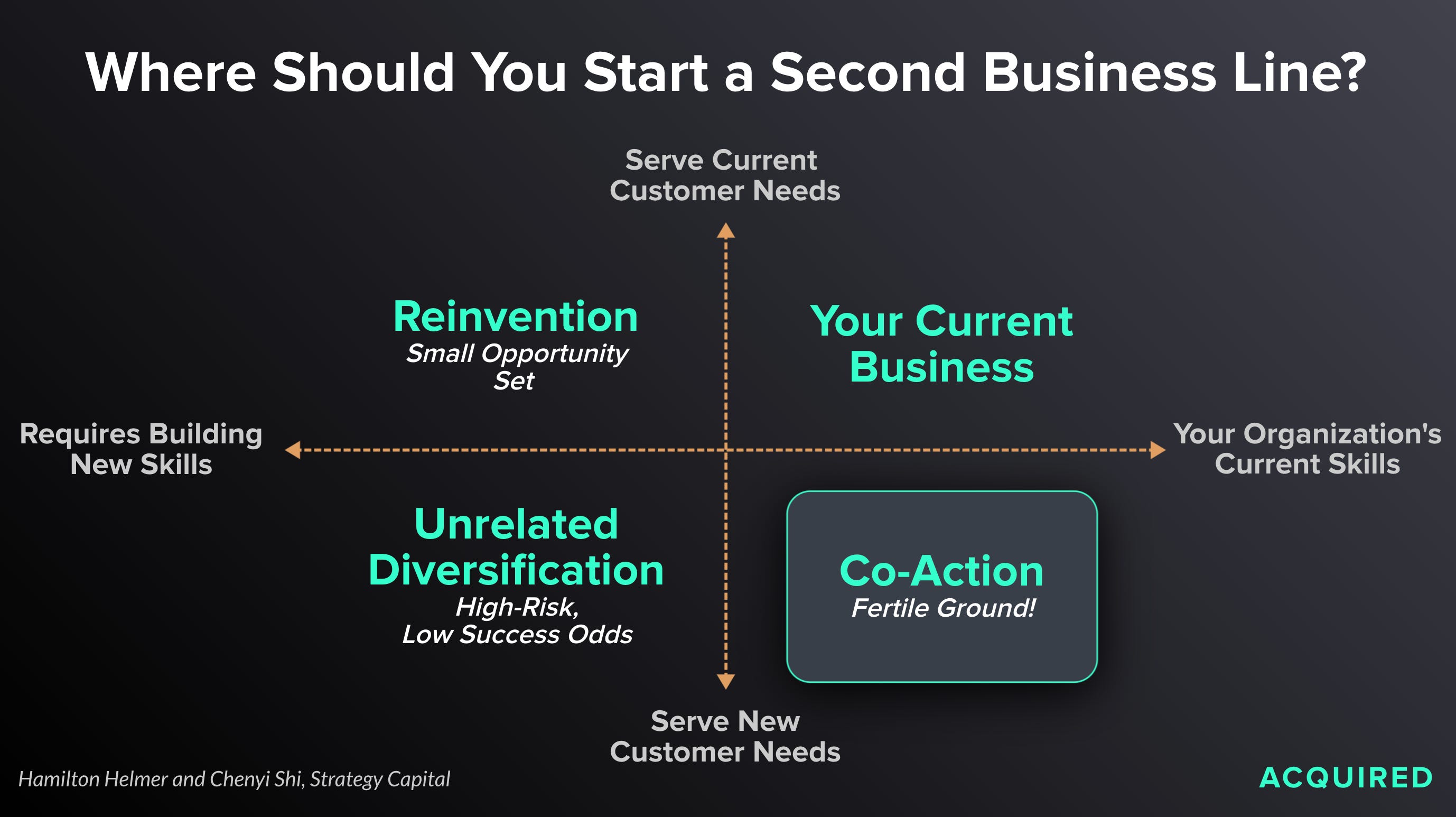
Ben’s Step-by-Step Summary
Step 1: Identify power—honest, granular.
Step 2: Pursue new businesses under power umbrella (low-risk).
Step 3: If not, use capabilities for new jobs, prioritizing differential skills.
Nintendo’s Power (1980s)
Both Scale (first-party games like Mario amortized over 95% market share) and Network Economies (third-party titles like Final Fantasy via dominant ecosystem). Vertical integration blends them; defending causal power key. Enabled transformation from cards/toys to consoles (coaction).
Additional Notes
Episode: Interview: Hamilton Helmer & Chenyi Shi on How to Build an AWS-Like Second Business
Related Episodes: