


Kyle’s Rating: 6/10
Hearing Daniel Ek tell Spotify’s story firsthand provides interesting insider perspective, particularly his candid admissions about the personal toll and accidental discoveries that shaped the company. However, the interview format lacks the narrative structure and deep analysis that makes Acquired’s standard episodes exceptional—it meanders between topics without the comprehensive research and storytelling that defines their best work.
Daniel Ek
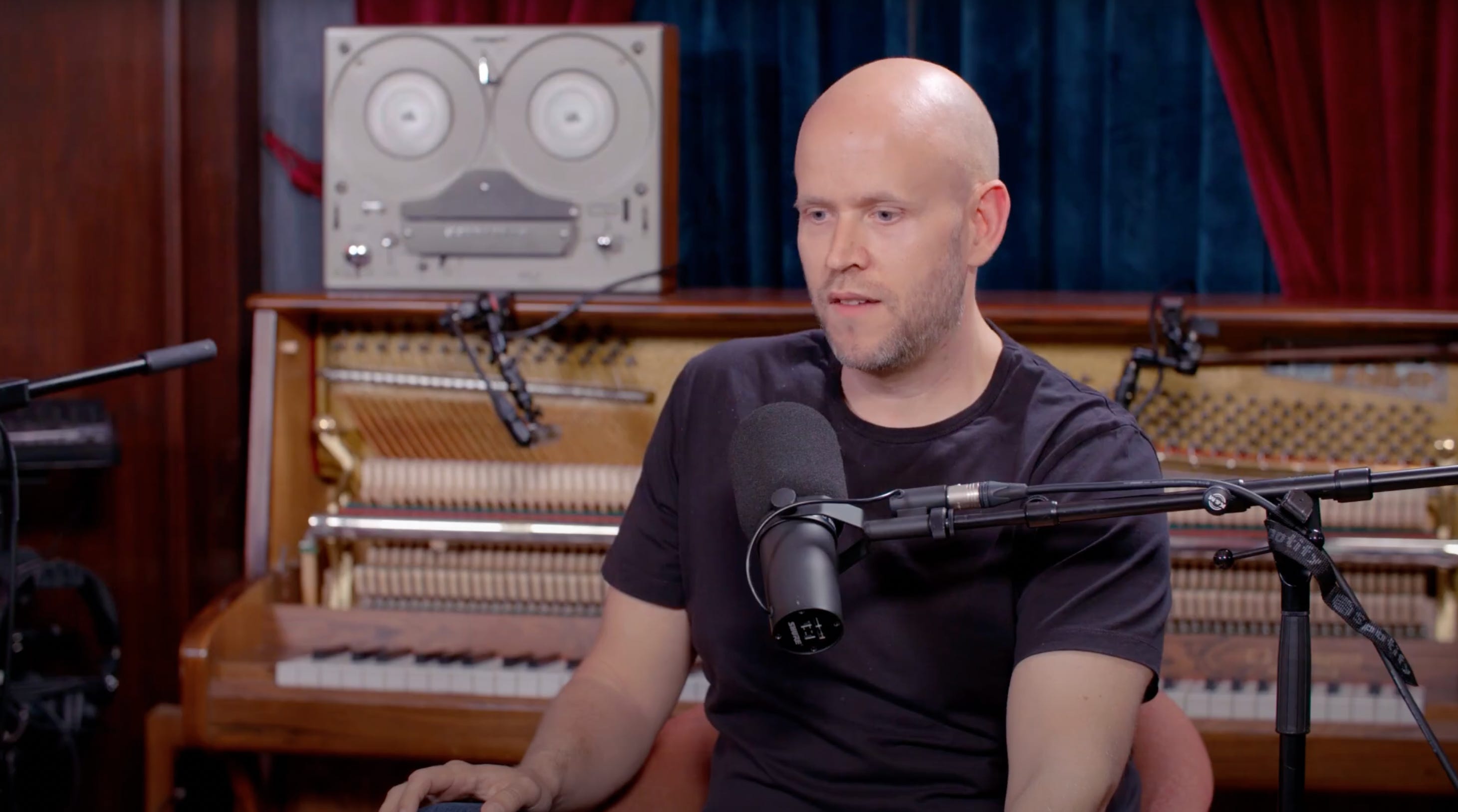
Daniel Ek is the founder and CEO of Spotify, credited with revolutionizing the music industry after the piracy era decimated CD sales. The interview captures Ek reflecting on Spotify’s transformation from a music streaming service to a comprehensive audio platform, his pivotal decisions in navigating industry relationships, and personal insights from building one of the world’s largest content platforms. The episode frames Ek’s journey through the lens of strategic expansions, cultural challenges, and the evolution of creator economies, with particular emphasis on Spotify’s recent pivot into podcasting and audiobooks.
Timeline
2006: Spotify founded in Stockholm by Daniel Ek and Martin Lorentzon
2008: Launch in select European markets (Sweden, UK) with geographical constraints due to licensing
2011: Spotify launches in the United States after three years of negotiations (originally expected three months)
2014 October: Taylor Swift removes her catalog from Spotify following release of “1989”
2017: Taylor Swift returns to Spotify after streaming becomes majority of industry revenue
2018: Spotify direct listing on NYSE
2019 January 1: Spotify has less than 1,000 Acquired podcast listeners
2019: Major push into podcasting begins with platform integration decision
2023: Spotify surpasses Apple as world’s largest podcast platform
2023: Over 500 million monthly active users, 200+ million paid subscribers
Notable Facts
$40 billion paid to artists: Spotify has distributed this amount over its lifetime, becoming the single largest source of revenue for the music industry
Hair loss from stress: Ek literally lost his hair during the early years of Spotify due to stress from delayed U.S. launch and near-death experiences
60%+ of Acquired’s audience: The podcast’s listenership on Spotify grew from essentially zero to overwhelming majority in just four years
100,000 content moderators: Ek references Meta employing this massive number, highlighting the hidden variable costs of user-generated content platforms
Key Decisions
Integration of Podcasting into Main App (2019)
Context/Rationale: While conventional wisdom dictated separate apps for different content types (following Facebook’s constellation strategy), Ek observed German users already uploading audiobooks to the platform. He realized the primitives built for music—discovery, ubiquity, freemium model—could serve podcasting equally well.
Outcome: Spotify transformed from essentially zero podcast market share to becoming the world’s largest podcast platform, surpassing Apple.
Analysis: This decision succeeded because Ek applied first-principles thinking rather than following industry orthodoxy. By recognizing that users don’t conceptualize content consumption by format but by context (similar to how radio combined talk, music, and sports), Spotify could leverage its existing 200+ million user base rather than trying to convince users to download a separate podcast app. The integration eliminated switching costs and brought podcasting to users who would never have self-identified as “podcast people.”
Geographical Constraint Strategy (2008-2011)
Context/Rationale: Unable to secure U.S. licensing initially, Spotify was forced to launch in limited European markets. Rather than viewing this as a setback, they embraced geographical density, focusing marketing efforts on college cities to achieve the “eight touchpoints” needed for user conversion.
Outcome: Built strong market positions in Sweden and UK before U.S. entry, creating proof points for skeptical labels and refining the product.
Analysis: The constraint became an advantage by forcing focus and iteration. Ek notes definitively that “Spotify would not have been alive today, had it not been that we couldn’t launch in the US as our first market.” The forced geographical rollout allowed them to perfect the model in smaller markets where they could achieve saturation and demonstrate streaming’s viability to skeptical rights holders.
Handling Taylor Swift’s Departure (2014)
Context/Rationale: When Swift pulled her catalog, Spotify faced potential cascade of artist departures. Rather than panic or compromise the model, Ek recognized that Swift was one of the few artists who could benefit from physical scarcity and didn’t need streaming.
Outcome: Swift returned in 2017 once streaming became the majority of industry revenue; no cascade of departures occurred.
Analysis: Ek’s restraint demonstrated strategic maturity—understanding that forcing binary choices (”all in with me or not”) wasn’t necessary. By 2017, streaming had become essential for reaching #1, even for Swift. The episode validated Spotify’s thesis while allowing both parties to optimize for their respective positions at different market maturity points.
Pursuing AI DJ Before AI Hype
Context/Rationale: Spotify developed AI DJ as a high-quality implementation focusing on music (avoiding the moderation complexity of podcasts) for background listening contexts where users wanted more context.
Outcome: One of the most popular AI products by reach, moving metrics as substantially as Discover Weekly.
Analysis: By choosing music over podcasting for AI implementation, Spotify avoided content moderation risks while serving a clear user need. The decision reflects their evolved cultural ability to know when to ship imperfect products (audiobooks) versus when to ensure quality (AI features under scrutiny).
Key Quotes
“Had you told me how hard this would have been, I would have never done it. I’m happy I went through it, but I would have never done it.”
Context: Reflecting on the emotional toll of building Spotify, including literal hair loss from stress
Analysis: This vulnerability dismantles the mythology of prescient founders, revealing how ignorance can be instrumental to attempting transformative ventures. Ek’s admission suggests that accurate risk assessment might paradoxically prevent the most impactful companies from being built.
“The fact that people doubt you in the beginning, you need to pay attention to that and hear what valid concerns they may have. But a bunch of that is just that they’re not used to the concepts.”
Context: Discussing resistance to combining podcasts and music in one app
Analysis: Ek articulates a crucial balance for innovators—remaining open to legitimate criticism while recognizing that true innovation often faces resistance simply because it violates existing mental models. His framework for evaluating doubt (valid concerns vs. conceptual unfamiliarity) provides a practical approach to navigating contrarian bets.
“Every really successful entrepreneur, in my opinion, has had at least three near death experiences with their company.”
Context: Discussing the reality of building Spotify versus media portrayals of entrepreneurship
Analysis: This observation reframes failure as a statistical necessity rather than an aberration, suggesting that resilience through multiple existential crises is a prerequisite for transformative success. It challenges the narrative of smooth exponential growth that dominates startup mythology.
“If you really zoom in on that exponential curve, it actually is a lot of different linear curves stacked on top of each other.”
Context: Explaining Spotify’s growth strategy of stacking different S-curves
Analysis: This mental model reveals how Spotify achieved 500+ million users not through a single strategy but through sequential market expansions and product additions. It suggests that sustainable hypergrowth requires constant reinvention rather than simply scaling a single playbook.
“I think the most important thing is to really think through and be really diligent about the culture you create... we were victims of that because we had taken all these different things.”
Context: Reflecting on Spotify’s cultural evolution and early mistakes copying from Google, Facebook, Amazon
Analysis: After 17 years, Ek identifies culture as the critical variable, warning against the “Frankenstein monster” of borrowing cultural expressions without understanding underlying principles. His distinction between culture and its expressions provides a framework for avoiding cargo cult management practices.
Industry Trends
Extremes winning in content duration: While 15-second clips dominate one end, three-to-five hour conversations simultaneously thrive—suggesting the “middle” of content length is disappearing. This bifurcation shaped Spotify’s home feed redesign, recognizing that merchandising three-minute songs requires fundamentally different UX than four-hour podcasts.
Democratization of creation through AI: Ek predicts AI will reduce music creation barriers by an order of magnitude, similar to how Instagram democratized photography. Rather than commoditization, Ek expects this to increase the value of top-tier creators while eliminating the middle tier—fine art photography prices rose despite Instagram’s ubiquity.
Attribution crisis in creator economy: Creators struggle to understand which platforms drive actual audience growth versus vanity metrics. This measurement challenge creates both underinvestment (creators staying too focused on single platforms) and overinvestment (spreading too thin across platforms).
Business model convergence toward freemium: All media models are moving toward freemium rather than pure ad-supported or pure paid models. The distinction between podcasts and audiobooks becomes primarily about business model (ad-supported vs. paid) rather than format.
Leadership Playbook
Ship imperfect products strategically: “We’re actually one of these companies that happily will release something out that’s not great” (on audiobooks launch)—but be intentional about when quality matters (AI DJ) versus when iteration speed matters. This selective perfectionism allows rapid market entry while protecting brand credibility on sensitive features.
Resist cultural borrowing: After years of copying Google’s 20% time and Facebook’s “move fast,” Ek learned that taking “cultural expressions” from other companies creates a “Frankenstein monster”—instead, be intentional about your unique culture. True competitive advantage comes from developing distinct cultural principles rather than mimicking successful companies’ surface-level practices.
Embrace constraints as advantages: Being forced to launch in Sweden/UK before the U.S. “definitively” saved Spotify—constraints force focus and prevent premature scaling. Geographic or resource limitations can create better products by requiring deeper market understanding before expansion.
Additional Notes
Episode Metadata:
Title: Spotify CEO Daniel Ek
Release Date: May 17, 2023
Duration: 1:38:07
Recorded live at Spotify HQ studio in Stockholm
Related Episodes:
Taylor Swift (Acquired’s Version) - Season 10, Episode 1 (1/23/2022)
Spotify’s Direct Listing - Season 2, Episode 6 (4/5/2018)
LVMH - Season 12, Episode 2 (2/21/2023)
Links: