

Kyle’s Rating: 10/10
A curated “greatest hits” from 200+ episodes. It’s a fun departure from the usual format. Ben and David’s chemistry shines as they distill hard-won insights from Sony to Oprah, perfect for both longtime fans and newcomers wanting the playbook distilled. It’s less a traditional episode and more a celebratory masterclass—like a live concert of Acquired’s best riffs.
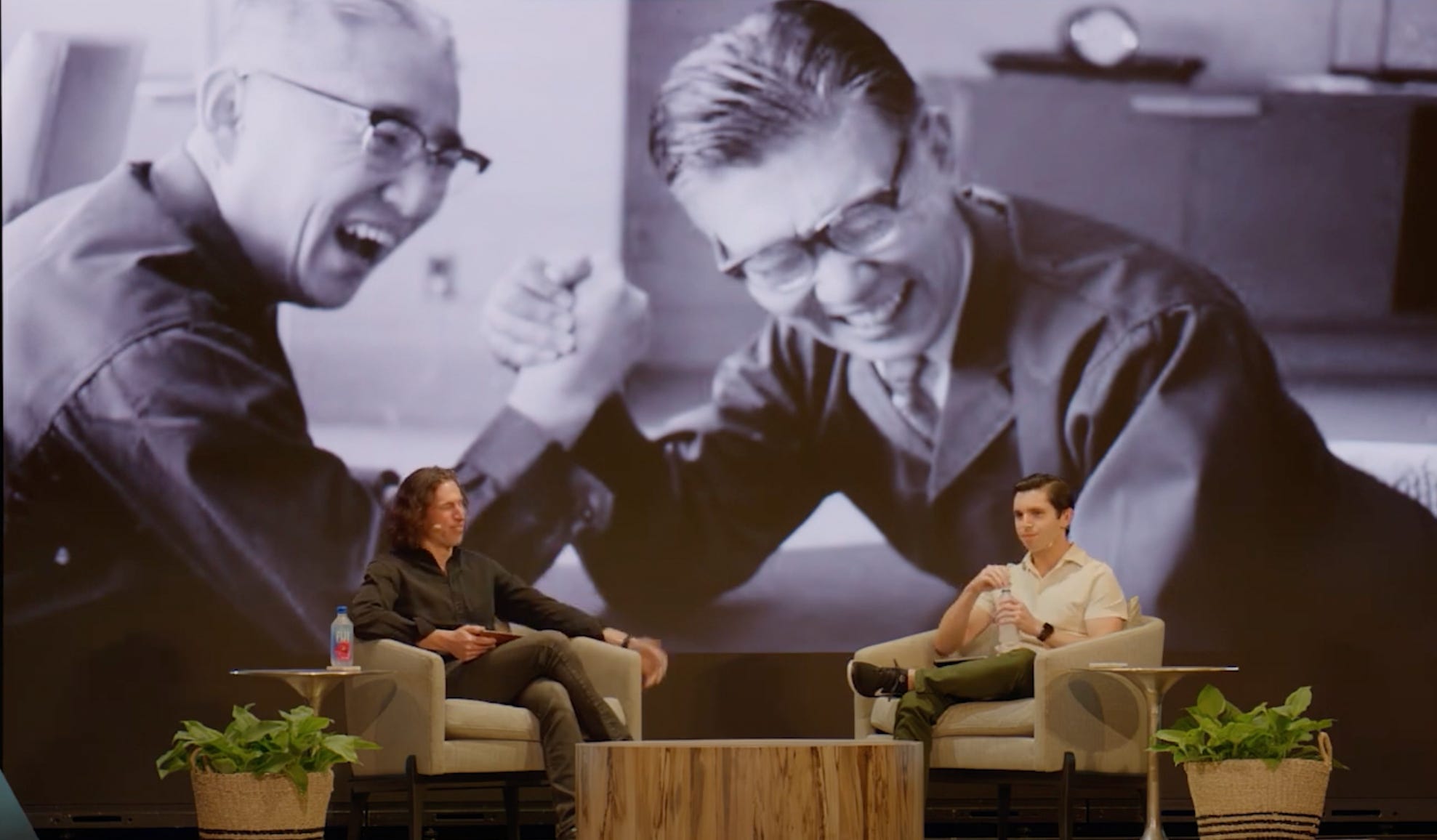
Ben and David distilled 12 key lessons from over 200 Acquired episodes after months of research, drawing from iconic company stories like Sony, NVIDIA, and Oprah for a special talk at Capital Camp.
1. Optimism Always Wins
Ben and David argue that optimism is the only rational stance for building world-changing companies, even in the bleakest conditions. In 1946 Japan, with GDP per capita at $17, half of Tokyo homeless, and no tech infrastructure, Akio Morita and Masaru Ibuka founded Sony with a wooden rice cooker, no market, and no military contracts. Their audacity built an icon that reshaped global consumer electronics and inspired Steve Jobs, who later said, “No Sony, no iPhone.” The insight: headwinds are real, but only optimists drive progress. Investors who back vision over macro noise capture outsized returns because the future is built by those who refuse to accept the present as permanent.
2. The Mike Moritz Corollary to Moore’s Law
Moritz realized that Moore’s Law, 10X compute every ~7 years, perpetually expands addressable markets by slashing costs. In 1990, a $2,000 486 PC reached 42% of Americans; today, a $200 smartphone with a million times the power serves over 6 billion globally. This enabled Sequoia to invest in Google, WhatsApp, Airbnb, and ByteDance. Log-scale charts show progress always feels like “nothing, then everything,” masking compounding. NVIDIA’s GPU leaps prove the law still holds. The takeaway: tech outcomes keep scaling as long as compute improves exponentially. Macro drawdowns are noise, and betting on the next wave is the only long-term play.
3. Let Your Winners Ride
Sequoia’s 1978 Apple exit, selling for 40X after 18 months, was history’s costliest mistake, missing trillions. Amazon’s post-IPO chart proves the point: 13 years from IPO yielded 10X, but holding to 2022 delivered 170X, with 99.98% of gains post-public. Growth duration, not annual rate, defines value. Venture’s TAM obsession stems from needing decades of runway. Paul Graham noted Amazon’s value accrued in the “out years.” The discipline: when a winner reveals multi-decade potential, volatility is irrelevant. Selling early is the only true error. Hold compounders through noise.
4. Nothing Can Stop a Will to Survive
Facing 80 funded graphics rivals and Intel integrating GPUs, NVIDIA was doomed. Wrong tech (quadrilaterals), limited capital. Jensen laid off 70%, emulated chips in software, shipped broken silicon, and disabled flawed functions, telling developers, “You only need 8 blend modes.” Survival birthed a decade lead. Zoom’s Eric Yuan still thinks “survive, survive, survive” daily, treating capital as trust. The hero’s journey demands adversity; game over only happens when founders quit. Raw will to outlast “everyone’s will to kill me” (Jensen) forges unbreakable moats when conventional playbooks fail.
5. Strength Leads to Strength
Each new resource, whether capital, talent, or customers, raises valuation; winners leverage it immediately into the next advantage. Andreessen Horowitz’s 2009 $300M Fund I splash signaled top-tier status; within a year, they raised $650M, scaling to $30-40B AUM in 13 years. Standard Oil’s Rockefeller used every refinery or railroad deal to reset power overnight. Tesla raised $10B in 2020 at a “crazy” valuation, turning market cap into balance-sheet fuel. The loop is merciless: strength unused atrophies; strength redeployed compounds geometrically. Complacency kills.
6. It’s Never Too Late
Tech waves reset with every 10X compute leap. Miss one, catch the next. Andreessen arrived in 1994 Silicon Valley thinking he’d missed the PC era, but timed the Internet perfectly with Netscape. TSMC’s Morris Chang founded at 56 after decades at TI, building the world’s 11th most valuable company and a geopolitical stabilizer. Pre-internet VC funded 50-something chip veterans; the “young founder” myth is a cloud-era blip. Mindset and paradigm timing trump age.
7. Don’t Mistake Options for Cash Flow
Venture isn’t DCF. It’s pricing call options on asymmetric outcomes. A $20M seed valuation models probabilities of $0 vs. $100B exits, explaining TAM obsession and portfolio necessity. Altos’ Ho Nam warns: startups aren’t lottery tickets. Founders have lives, and VC is a multi-turn reputational game. Public investors discount cash flows; VCs blend optionality with traction. Silicon Valley’s grace stems from repeated games where today’s failure may build tomorrow’s unicorn.
8. Focus on What Makes Your Beer Taste Better
Bezos’ 1900s brewery analogy: early electrified plants built power stations; successors rented from utilities and crushed them. Electricity source never affected taste. AWS gained a 5-year lead evangelizing this at 2008 YC. Airbnb’s founders were in the room. Being the unregulated utility is the real moat: AWS turned Amazon profitable; Square, Shopify, and Vanta followed. Outsource everything non-differentiating. Specialization of labor at scale wins on margins and speed.
9. Scale Up or Niche Down
The internet barbells industries. Middle players die. Brooks slashed from $60M “everything” shoes (losing $5M/year) to $30M performance-running focus, blowing up big-box distribution. Twenty years later: $1.2B revenue, 30-40% CAGR. The New York Times scaled globally with massive fixed costs while mid-tier papers went bankrupt. Acquired niched to 3-hour deep dives, aggregating 250k obsessives in seven years. Pick a polarity, commit fully, endure short-term pain for long-term viability.
10. Don’t Be Talent, Own the Business
Media millionaires create; billionaires own IP. Oprah’s advisor said, “Don’t be talent, own the business.” She never sold rights, scaling Harpo from a local show into a billionaire empire. Taylor Swift re-recorded her catalog to reclaim masters, upending music economics. The internet, through Substack, YouTube, and TikTok, removes gatekeepers. Talent commoditizes; ownership compounds forever.
11. You’ll Get the Partners You Ask For
Bezos’ 1997 letter declared, “Prioritize growth, scale central,” enabling 20 years of reinvestment with no retail profit until AWS. Loud signaling aligned stakeholders and repelled short-term thinkers. Acquired chose 3-hour episodes over weekly cadence, attracting ideal listeners over seven years. Clarity on trade-offs enables extreme execution; ambiguity invites second-guessing.
12. Have Fun
Joy is the ultimate moat. Unfakeable marketing, unsustainable work ethic. Acquired’s 7-year “blast” running 3-hour deep dives built a 250k-strong community through pure enjoyment. The Arena Show with Packy and Mario was pure delight. Bill Gurley: passion-driven founders “run farther, longer, faster” than those for whom it’s work. Fun compounds endurance and attraction; misery leaks.
Additional Notes
Episode Metadata
Duration: 1:07:58
Release Date: June 19, 2022
Related Episodes
Strength Leads to Strength is so accurate. Great read.
True to my experience as a nine time successful entrepreneur with my wife as co founder and business builder to my idea guy