

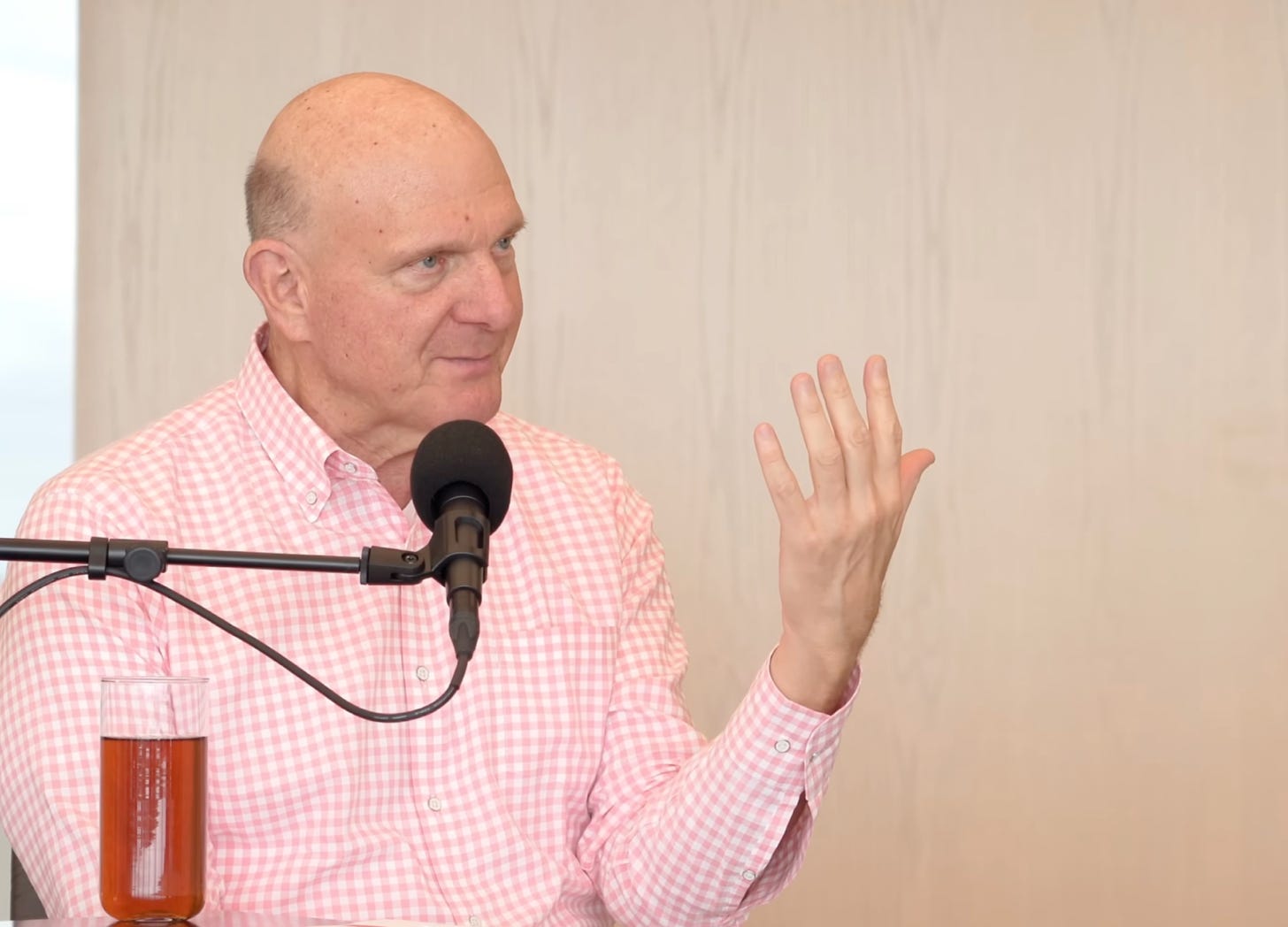
Kyle’s Rating: 8/10
This high-octane interview captures the “muy macho” energy of the man who turned Microsoft’s enterprise arm into a $3.5 trillion fortress while planting the early seeds for Azure. Ben and David brilliantly balance nerdy celebration with a candid post-mortem on the mobile and search misses, making it an essential, three-hour roller coaster for any tech history buff.
Overview
Name and Roles: Steve Ballmer, former Microsoft CEO (2000–2014), president (1998–2000), and LA Clippers owner (2014–present).
Industry Significance: A tech legend who scaled Microsoft’s enterprise business, defined modern software licensing, and became the world’s top investor by holding Microsoft stock; now reshaping NBA fan experiences with Intuit Dome.
Interview Focus: Ballmer reflects on Microsoft’s rise, from the IBM DOS deal to Azure’s roots, candidly dissecting mobile and search misses, his complex relationship with Bill Gates, and his CEO exit. Ben and David probe his enterprise playbook, leadership philosophy, and Clippers passion, marveling at his PowerPoint prep and “developers, developers, developers” energy.
Ben and David’s Approach: They geek out over Ballmer’s unfiltered stories, like his 16 trips in 16 weeks to IBM, and push for context on iconic moments, blending awe for his enterprise wins with sharp questions about strategic stumbles.
Career and Impact
Narrative Summary
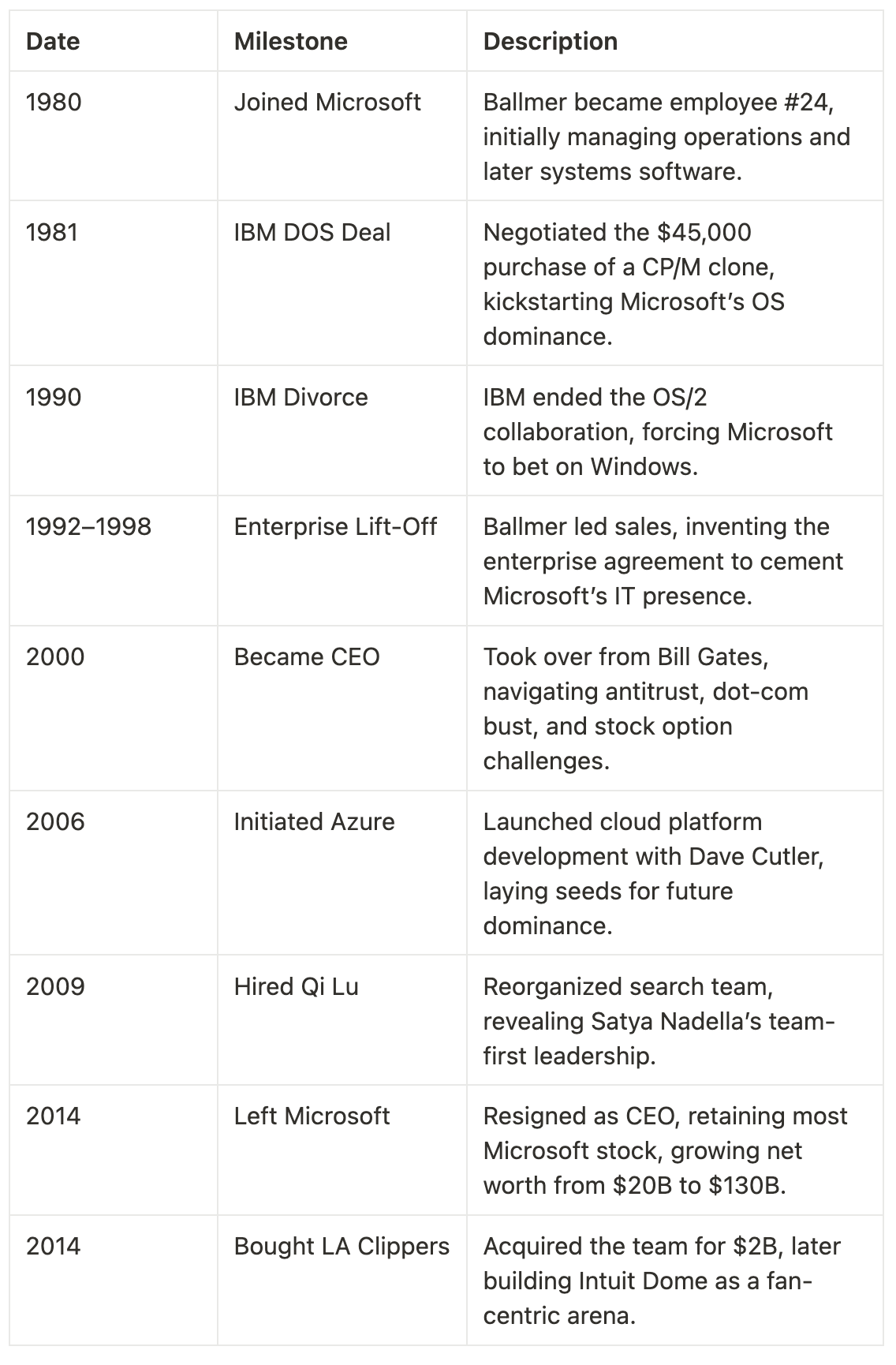
Steve Ballmer’s career is a high-energy saga of grit, luck, and relentless ambition, as Ben and David unpack with nerdy glee. Joining Microsoft in 1980 as its 24th employee, Ballmer was the business muscle behind Bill Gates’ technical vision, turning a scrappy software startup into a $3.5 trillion colossus. His early masterstroke—snagging a CP/M clone for $45,000 to create MS-DOS—catapulted Microsoft into the PC revolution, a deal Ballmer calls “pretty good” with a sly grin. By outmaneuvering IBM’s proprietary instincts, he laid the foundation for Microsoft’s platform dominance, as developers flocked to DOS, cementing its role as the industry’s linchpin. Yet, Ballmer’s true legacy lies in his relentless pivot to enterprise, a transformation that redefined Microsoft’s trajectory and secured its enduring might.
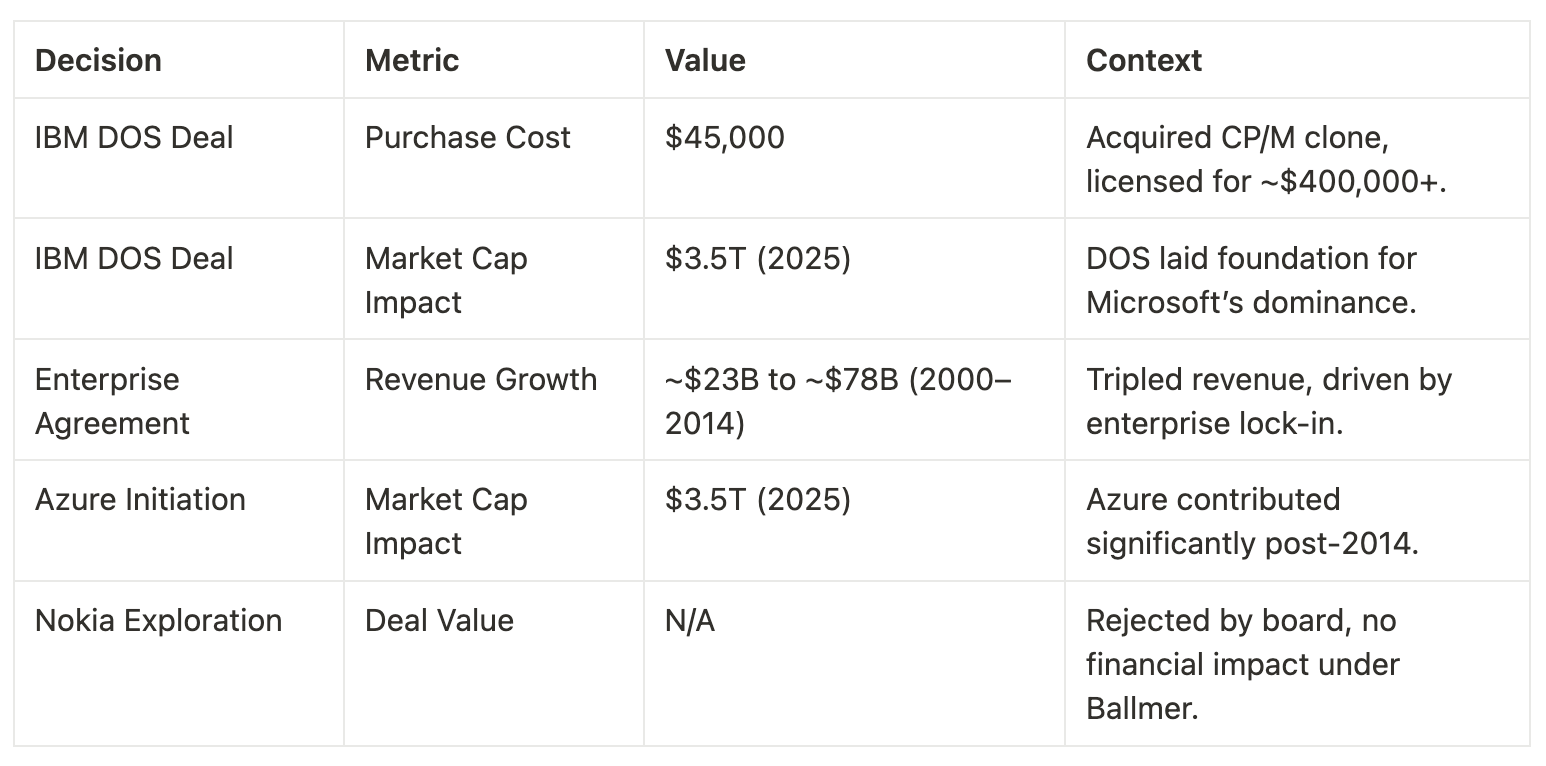
In the 1990s, Ballmer faced IBM’s “sun, moon, and stars” dominance, a Goliath that could “squish” Microsoft like a bug. Undaunted, he forged the enterprise agreement, a recurring revenue model that locked IT departments into Microsoft’s ecosystem with “peace of mind” insurance for CIOs. “Muy macho,” he boasts, proud of building an enterprise muscle that competitors like Oracle couldn’t match. This innovation, born from 16 grueling trips to IBM in 16 weeks, tripled Microsoft’s revenue to ~$78B by 2014, making it enterprise-grade despite skeptics claiming it wasn’t ready until the late 2000s. Ballmer’s developer rallying cry—“developers, developers, developers” in 1999—fended off Linux and IBM’s OS/2, creating network effects that solidified Microsoft’s platform. His competitive zeal, honed against the “bear” of IBM, reshaped tech, but his Windows-centric mindset foreshadowed challenges in new paradigms.
Ballmer’s foresight shone in 2006 when he launched Azure, recruiting Dave Cutler to counter AWS’s cloud rise, building on the 1990s “Energizer” vision. “God dang it, this is our future,” he rallied, planting seeds that fueled Microsoft’s $3.5T valuation under Satya Nadella. Yet, his tenure as CEO (2000–2014) was a rollercoaster: he navigated antitrust woes and a dot-com bust, quadrupling profits, but stumbled in mobile and search. Clinging to a “Windows everywhere” mantra, Ballmer misfired with Windows Mobile and Windows Live Search, underestimating Android’s free model and Google’s ad-driven scale. “We were locked in our model,” he admits, a candid regret Ben challenges as a failure to see mobile as a “different start-up.” These misses cost Microsoft a consumer foothold, a shadow over Ballmer’s enterprise triumphs that Ben and David dissect with relish.
Post-Microsoft, Ballmer’s passion roared through the LA Clippers, purchased for $2B in 2014, and Intuit Dome, a fan-first basketball cathedral. Its 51-row “wall” slashes opponents’ free-throw percentages, embodying his competitive fire, while an acre of scoreboard screams his obsession with intensity. Ben and David marvel at Ballmer’s loyalty, holding Microsoft stock to amass a $130B fortune, funding Ballmer Group’s ~$1B annual philanthropy. His Clippers venture mirrors Microsoft’s enterprise lock-in, creating a fan experience as sticky as Office was for IT. Yet, Ballmer laments losing Microsoft’s consumer soul, a paradox that defines his legacy: a titan who built an enterprise empire but skated behind mobile’s puck, leaving a dual narrative of triumph and what-ifs.
Ballmer’s impact spans tech and sports, a testament to his relentless drive and ability to “ride the bear” of competition. His enterprise agreements and Azure’s roots secured Microsoft’s $3.5T market cap, a legacy Ben and David celebrate as underappreciated. In sports, Intuit Dome’s fan-centric design rivals Microsoft’s IT dominance, with Ballmer’s $1B philanthropy reflecting a redemptive arc. Yet, his mobile and search failures sting, a cultural inertia from a “platform company” mindset he couldn’t fully shake. His strained relationship with Gates, including a year of silence, underscores the personal toll of his grind. Ballmer’s story is one of monumental value creation, but also missed consumer capture, a saga Ben and David unpack with awe for his enterprise muscle and curiosity for the roads not taken.
Notable Facts
Enterprise Pioneer: Ballmer “fathered” Microsoft’s enterprise business, creating the enterprise agreement model that defined modern software licensing.
“Developers, Developers, Developers”: His 1999 chant at a developer conference rallied third-party support against IBM, Linux, and open-source threats.
Investment Legend: By holding Microsoft stock, Ballmer’s net worth grew from $20B in 2014 to $130B in 2025, making him “arguably the very best investor of the last 20 years.”
Clippers Visionary: Built Intuit Dome with a fan-first design, including a 51-row “wall” and an acre of scoreboard, prioritizing basketball intensity over revenue.
Philanthropy Scale: Through Ballmer Group, he and Connie give away ~$1B annually, funded partly by Microsoft’s dividend checks.
Key Decisions
Decision 1: IBM DOS Deal (1981)
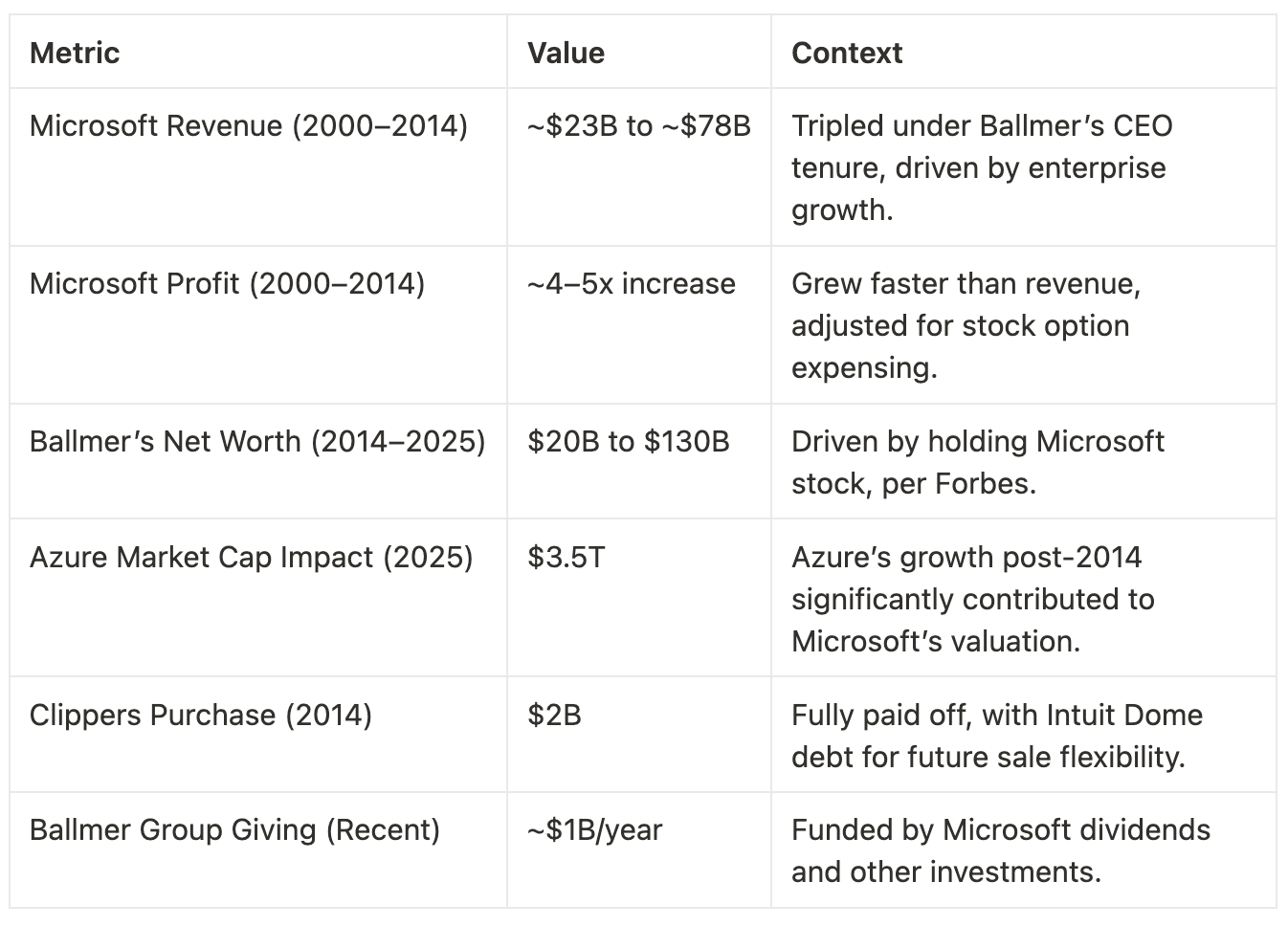
Context: In 1980, IBM approached Microsoft for an operating system, mistakenly believing Microsoft owned CP/M. Steve Ballmer, alongside Paul Allen and Bill Gates, acquired a CP/M clone from Seattle Computer Products for $45,000, birthing MS-DOS.
Strategic Rationale: Capitalized on IBM’s PC project, securing a non-exclusive licensing deal to supply DOS to other manufacturers, betting on ecosystem control.
Outcome: DOS standardized the PC industry, positioning Microsoft as the developer platform, fueling its ascent to a $3.5 trillion market cap.
Ben and David’s Take: Ben dubs it “the single greatest business deal in history,” awestruck by its role in kickstarting Microsoft’s dominance.
Impact and Analysis: This “lucky” masterstroke made Microsoft the PC ecosystem’s linchpin, outmaneuvering IBM’s proprietary instincts. Ben’s awe underscores its genius, as DOS’s developer traction created network effects that IBM couldn’t replicate, laying Microsoft’s foundation.
Quote: “We sold it to [IBM] for half of what we paid for it… Pretty good deal,” Ballmer recalls, grinning at the serendipity.
Decision 2: Enterprise Agreement Invention (~1992–1998)
Context: In the early 1990s, Microsoft sold single software copies to hobbyists, lacking enterprise traction. Ballmer, leading sales, sought to challenge IBM’s IT dominance.
Strategic Rationale: Developed the enterprise agreement, a recurring revenue model charging per machine over three years, simplifying licensing and guaranteeing upgrades.
Outcome: Locked IT departments into Microsoft’s ecosystem, achieving enterprise-grade status by the late 2000s, tripling revenue to ~$78B.
Ben and David’s Take: They laud Ballmer as the “founder of Microsoft’s enterprise business,” marveling at how it redefined software licensing.
Impact and Analysis: Born from outmaneuvering IBM’s “bear,” this created a recurring revenue fortress, as David’s praise highlights. It ensured “peace of mind” for CIOs, insulating Microsoft from consumer volatility and crushing competitors like Lotus Notes.
Quote: “We solved the upgrade price problem, and we solved the difficulty of administration problem,” Ballmer explains.
Decision 3: Initiating Azure’s Development (2006)
Context: AWS launched in 2005, signaling cloud computing’s rise. Ballmer, building on Microsoft’s 1990s “Energizer” vision, tasked Dave Cutler and Amitabh Srivastava with creating Azure.
Strategic Rationale: Aimed to build a Platform-as-a-Service cloud leveraging Windows developers, countering AWS and ensuring Microsoft’s backend relevance.
Outcome: Azure laid infrastructure for Microsoft’s cloud dominance, gaining “some momentum” by 2014 and fueling its $3.5T valuation under Nadella.
Ben and David’s Take: They note Ballmer “knew how great Azure was going to be,” but the world didn’t, praising his foresight despite later momentum.
Impact and Analysis: Ballmer’s vision planted cloud seeds that blossomed into a $3.5T pillar, though AWS outpaced early efforts due to Microsoft’s Windows focus. Ben and David’s nod to his foresight underscores Azure’s disruptive potential against IBM’s backend dominance.
Quote: “God dang it. This is our future,” Ballmer rallied, underscoring cloud’s inevitability.
Decision 4: Exploring Nokia Acquisition (~2011–2013)
Context: Microsoft faltered in mobile, missing a 2008–2009 Verizon design win. Ballmer explored acquiring HTC or Nokia to integrate hardware, countering Apple and Android.
Strategic Rationale: Believed hardware control was essential for a consumer future, as Nokia’s partnership lacked marketing funds to compete.
Outcome: The board rejected the Nokia deal, prompting Ballmer’s resignation. Microsoft later acquired Nokia, but the effort floundered without his drive.
Ben and David’s Take: They probe Ballmer’s mobile miss, implying the Nokia rejection was a strategic fumble that cost Microsoft a consumer foothold.
Impact and Analysis: Ballmer’s consumer ambition clashed with board conservatism, a miss Ben and David dissect as a mobile tragedy. The Windows-centric approach failed against Android’s free model, highlighting cultural inertia Ballmer couldn’t overcome.
Quote: “If we’re not going to buy a phone, that’s my best shot for a consumer future,” Ballmer laments.
Industry Trends
PC Revolution:
Term: Ballmer describes IBM as “the sun, the moon, and the stars” in 1980, with the PC revolution disrupting mainframes.
Significance: Enabled Microsoft’s DOS deal to standardize PCs, creating a developer ecosystem.
Impact: Ballmer leveraged this to outmaneuver IBM, but clung to Windows too long, per Ben’s critique.
Cloud Computing:
Term: Ballmer references “Energizer” (1990s) and Azure (2006) as cloud precursors.
Significance: Shifted IT from on-premises to scalable infrastructure, with AWS emerging in 2005.
Impact: Ballmer’s Azure bet built capabilities, but Microsoft lagged AWS due to Platform-as-a-Service focus.
Mobile Era:
Term: Ballmer calls mobile a “new trick” distinct from Windows, misjudged as an extension.
Significance: Redefined client devices, with Android and iOS dominating by 2008.
Impact: Microsoft missed a 2008–2009 Verizon window, as Ballmer laments, due to Windows-centric constraints.
Analysis
These trends shaped Ballmer’s Microsoft tenure, amplifying his successes and exposing his blind spots. The PC revolution handed him the DOS deal, a “lucky” springboard to standardize platforms, outflanking IBM’s proprietary model. His enterprise agreements capitalized on this, locking in IT as PCs proliferated. Cloud computing, sparked by Ballmer’s Energizer and Azure visions, positioned Microsoft to challenge IBM’s backend dominance, though AWS’s Infrastructure-as-a-Service model scaled faster. The mobile era, however, tripped him up: Ballmer’s failure to see phones as a “different start-up” cost Microsoft a client platform, as Android’s free model and Apple’s hardware prowess outpaced Windows Mobile. Ben and David link these trends to Ballmer’s leadership playbook, noting his developer focus thrived in PCs but faltered in mobile, where “consumer apps” waned by 2006. Ballmer’s competitive advantage lay in enterprise and cloud trends, but mobile’s risks left him skating behind the puck.
Leadership Playbook
Building Muscle:
Term: Ballmer emphasizes “building a muscle ahead of time,” like enterprise sales in the 1990s and Azure in 2006.
Impact: Created Microsoft’s enterprise dominance and cloud foundation, ensuring scalability.
Implication: Leaders must invest in capabilities before markets mature, as Ballmer did with Azure but failed with mobile hardware.
Team-First Culture:
Term: “Dedicated to making others better,” seen in the Qi Lu hire (2009).
Impact: Satya Nadella’s willingness to work under Qi Lu showcased team-first humility, enabling Ballmer to groom him for CEO.
Implication: Prioritizing team success over ego drives innovation, a lesson Ballmer applied in sports with player accountability.
Extreme Accountability:
Term: “Sports is so much more accountable than business,” Ballmer says, citing the Clippers’ 24-second shot clock.
Impact: Fostered real-time feedback at Microsoft (e.g., developer conferences) and Clippers, where players hold each other accountable.
Implication: Leaders must embrace transparency, as Ballmer’s “open and respectful” mantra drove performance.
Analysis
Ballmer’s leadership playbook, dissected by Ben and David with nerdy zeal, blends intensity with strategic foresight. “Building muscle” defined his enterprise and cloud pushes, turning Microsoft from a consumer upstart into an IT and cloud titan through relentless sales innovation and Azure’s early bets. His team-first culture shone in the Qi Lu hire, where Satya’s humility signaled CEO potential—a move Ballmer calls “pivotal.” In sports, Ballmer learned extreme accountability from the NBA’s unforgiving pace, applying it to Microsoft’s developer battles and Clippers’ game plans. These themes shaped his success: enterprise agreements locked in IT, while developer focus fended off Linux and IBM. Yet, his failure to “shake the system” for mobile highlights a cultural rigidity, as he admits frustration with Microsoft’s “platform company” mindset. For leaders, Ballmer’s playbook teaches investing in future capabilities, fostering selfless teams, and embracing real-time accountability—lessons as potent as his Intuit Dome’s “swell.”
Powers
Power: Network Effects (inferred from Ballmer’s developer ecosystem focus).
Application:
Ballmer’s “developers, developers, developers” chant (1999) rallied third-party developers to extend Windows, Office, and server platforms, creating a virtuous cycle of app growth.
Enterprise agreements reinforced network effects by locking IT departments into Microsoft’s ecosystem, integrating tools like Active Directory and Exchange.
Reasoning: The more developers built for Microsoft’s platforms, the more valuable they became, as seen in DOS’s dominance and Office’s enterprise ubiquity.
Impact:
Strengthened Microsoft’s enterprise position against IBM and Linux, enabling its $3.5T market cap.
Failed to extend to mobile, where Android and iOS captured developer ecosystems, as Ballmer admits, “We didn’t have the stuff.”
Analysis
Network Effects, though not named explicitly, powered Ballmer’s Microsoft strategy. His developer-centric approach—epitomized by the 1999 chant—created a platform where third-party apps amplified Windows and Office’s value, a dynamic Ben calls “the point of integration.” Enterprise agreements supercharged this by making Microsoft’s tools indispensable to IT, integrating them into a “holy trinity” of Windows, Office, and server infrastructure. This power crushed competitors like Lotus Notes and IBM’s OS/2, cementing Microsoft’s enterprise dominance. However, Ballmer’s inability to replicate these effects in mobile—where Apple and Android won developers—cost Microsoft a client platform. His focus on extensibility, linking to his “platform and app” playbook, underscores a strength that faltered in new paradigms. Ben and David’s awe at Ballmer’s enterprise lock-in reflects this power’s enduring impact, even as mobile’s miss lingers.
Reflections
Ben and David’s Assessment
Successes: Ben and David laud Ballmer’s enterprise transformation, calling him the “founder of Microsoft’s enterprise business,” which defines its $3.5T market cap today. They praise his Azure foresight and stock loyalty, growing his net worth to $130B.
Misses: They critique Ballmer’s mobile and search stumbles, noting Microsoft “stuck with Windows too long,” missing Android’s free model and Google’s ad-driven search dominance.
Overall: They view Ballmer as a tech titan whose enterprise wins were monumental but tempered by consumer market failures, marveling at his resilience and Clippers passion.
Strengths and Criticisms
Strengths:
Enterprise Innovation: Ballmer’s enterprise agreements and sales model made Microsoft indispensable to IT, a “muy macho” muscle he built from scratch.
Developer Focus: His “developers, developers” chant rallied third-party support, sustaining Microsoft’s platform against IBM and Linux.
Loyalty: Holding Microsoft stock showcased his belief in the company, earning him “best investor” status.
Criticisms:
Windows-Centric Mindset: Ballmer’s “Windows everywhere” strategy faltered on mobile and search, as he admits, “We tried to be too Windows-ey.”
Cultural Inertia: Struggled to shift Microsoft’s “platform company” culture, limiting mobile agility.
Bill Gates Tension: His strained relationship with Gates, including a year of silence (2000–2001), hindered strategic alignment.
Good for the World vs. Bad for the World
Good: Ballmer’s philanthropy via Ballmer Group (~$1B/year) tackles education and economic opportunity, reflecting his social impact. Intuit Dome’s fan-first design enhances sports culture.
Bad: The antitrust saga (1998–2011) damaged Microsoft’s reputation, with Ballmer noting it felt like a “personal attack” on culture, eroding morale.
Value Creation vs. Value Capture
Value Creation: Ballmer delivered immense value to Microsoft stakeholders, tripling revenue and profit, building Azure’s foundation, and enabling a $3.5T market cap. His Clippers investment created a vibrant fan experience.
Value Capture: Captured $110B in personal wealth growth ($20B to $130B), largely from stock holdings, and funds philanthropy via dividends, aligning with Microsoft loyalty.
Analysis
Ben and David’s reflections paint Ballmer as a transformative yet flawed leader, a narrative he embraces with candor. His enterprise prowess—forging a sales model from “nothing” to dominate IT—earned Microsoft’s enduring strength, a feat they celebrate as underappreciated. Azure’s roots, sparked by Ballmer’s 2006 push, underscore his vision, though Satya Nadella reaped the cloud’s glory. Yet, Ballmer’s mobile and search failures loom large: Ben challenges the Windows Mobile bet, and Ballmer admits they “didn’t see things as different enough.” His cultural struggles, from antitrust morale hits to Gates’ tension, reveal a leader wrestling with a complex legacy. His philanthropy and Clippers ventures show a redemptive arc, channeling his intensity into social good and fan joy. Ballmer’s story is one of value creation—building Microsoft’s enterprise and cloud backbone—but also missed capture in consumer markets, a duality Ben and David dissect with nerdy relish.
Additional Notes
Episode Metadata:
Number: Summer 2025, Episode 1
Title: The Steve Ballmer Interview
Release Date: June 1, 2025
Duration: 2:59:21
Related Episodes:
Microsoft Volume I (Season 14, Episode 4, 4/21/2024)
Microsoft Volume II (Season 14, Episode 6, 7/21/2024)
Amazon Web Services (Season 11, Episode 3, 9/5/2022)